I’ve been finding the learning curve for flying in acro mode surprisingly steep. It got me thinking: why should every pilot have to adapt to essentially the same controller behaviour, rather than having the controller adapt to the pilot?
That’s the idea behind ARC (Adaptive Radio Control) - an experimental Windows 10/11 application exploring software-based optimisation of drone control precision, responsiveness and consistency through personalised control profiles.
Unlike conventional EXPO and fixed rate adjustments, ARC aims to analyse individual control behaviour and develop adaptive, pilot-specific response characteristics rather than relying solely on predefined sensitivity curves.
The prototype will work with compatible controllers, including RadioMaster and other RC transmitters with USB joystick functionality.
No hardware modifications are required. ARC is currently intended for simulator-based testing and evaluation.
Sounds quite interesting but it does seem like a solution to a problem a lot of people don’t have (given practise time of course). I doubt it will ever find its way into the rule books associated with competitive flying of any kind … so, what’s the point I guess??? … same reason gyros aren’t permitted in any kind of F3A or IMAC rc fixed wing flying…
The point is to make effective FPV flying accessible to more people, including those who may not have the natural coordination or motor skills needed to master acro mode quickly.
ARC explores whether software can compensate for individual differences in control ability without sacrificing precision or responsiveness.
It’s intended for applications where competitive flying rules aren’t a constraint. The question is whether such system can improve actual pilot performance, not whether the system would be permitted in a competition.
As someone who has a Neo 1 with goggles and not forced to fly it in full Manual mode, this isn’t something I’m likely to encounter, BUT I think there are potential use cases for it.
After all, Electronic Arts have been putting out Formula One games for a quarter of a century and still include brake and steering assists in the most recent versions.
lack of training – if the pilot just lacks the dexterity that comes with stick time, altering the feedback will likely hinder his progress in the long term (compounding bad habits and all that). Even expo for example is largely seen as a band aid that you remove later once stick precision is no longer an issue.
lack of capacity – if the pilot already maxed out his dexterity and cannot physically push the boundary, then there is possibly a gap but more likely in the analysis of the input pattern. The current tool - expo, smoothing, … should cater for most case scenario? (thinking shaking, lack of precision,..). If reaction time is the issue (flying acro means maintaining an unstable system at float) you can even use things like Angle/Horizon modes where this instable nature of the drone is taken out.
Out of curiosity - what are you finding difficult learning to fly acro? Are you using training/tutorials?
considering fpv is not a discipline that repeats the same flight exactly everytime, or even frequently the software could not learn the resonse so it could compensate. There will always be a speed diferential at which a drone approaches an obsticle.
no computer has ever been able to predict a random pattern, hence why itt is called a RANDOM pattern, and fpv is a random pattern of movements in reaction to the previous radom movement which was in response to the drone heading on a random trajectory dictated by the last responses all instigated by a human.
not manpower. if you want to become proficient in any discipline. it is dedication and effort which will determine how good you become.
Like riding a bike, you dont learn to ride one properly until you remove the stabilisers.
I’ve been threatening to learn ACRO flying for years now but still not got round to it
BUT
when I do I want to do it the normal way using sims, loads and loads of practise and a tough quad. I don’t see any advantage in what is being proposed here
I agree with @Cedric Cedric’s comment ‘compounding bad habits’
I think what you want to create @minipax is a really great and interesting idea.
I fly my Neo 2 on Sports mode when I want to fly in small places. I fly my Avata 2 with the Motion 3 controller when I want FPV but with assistance from the Drone to keep me in the air. I have the FPV Controller so that when I am ready to fly manual I can. I think though that if you are flying DJI FPV you have two modes, either Normal & Sports or Manual. I can’t see people wanting a 3rd option where they fly Manual but with assistance as to me that is just Normal/Sports mode.
Can I just ask for some clarity here, is this intended to be used on what would be considered “store bought” camera drone equipped with stabilising gimbals etc, or self built FPV whoops that ONLY have manual accro mode as an option?
For context, I get the point of it on the latter but fail to see the appeal on the former.
Right now it is about testing primary research hypothesis - can individualised, software-optimised control mappings improve manual FPV drone flight precision, consistency and learning efficiency compared with conventional fixed EXPO and rate settings, without sacrificing responsiveness or full control authority.
Testing a simple idea - can drone controls work better if the software adapts to the individual pilot, rather than the pilot having to adapt to the controller? Everyone moves the sticks slightly differently. Idea is to learn those differences and adjust how the drone responds, potentially making flying more precise, consistent and easier to learn, without making the drone slower to respond or limiting what the pilot can do.
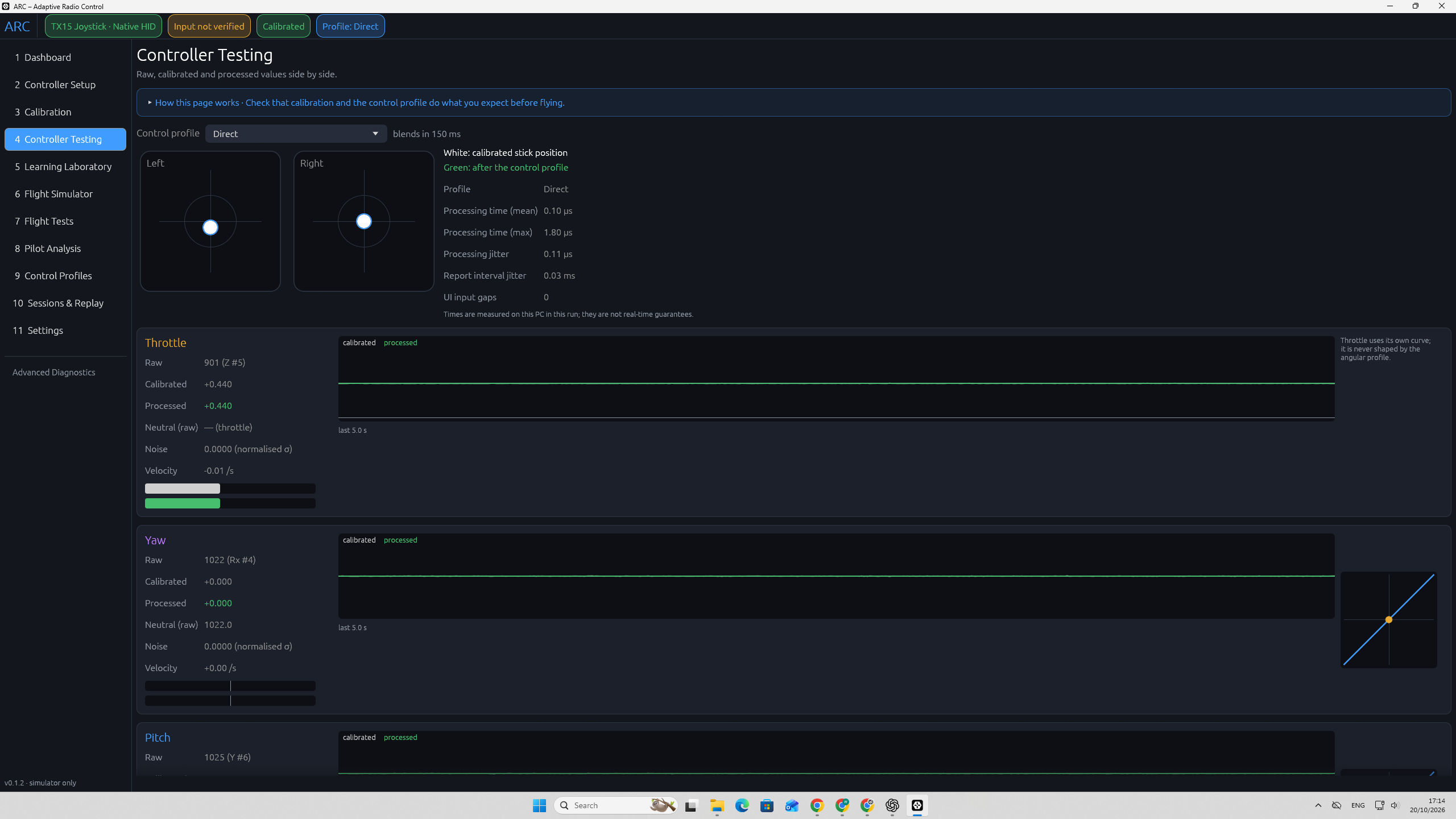
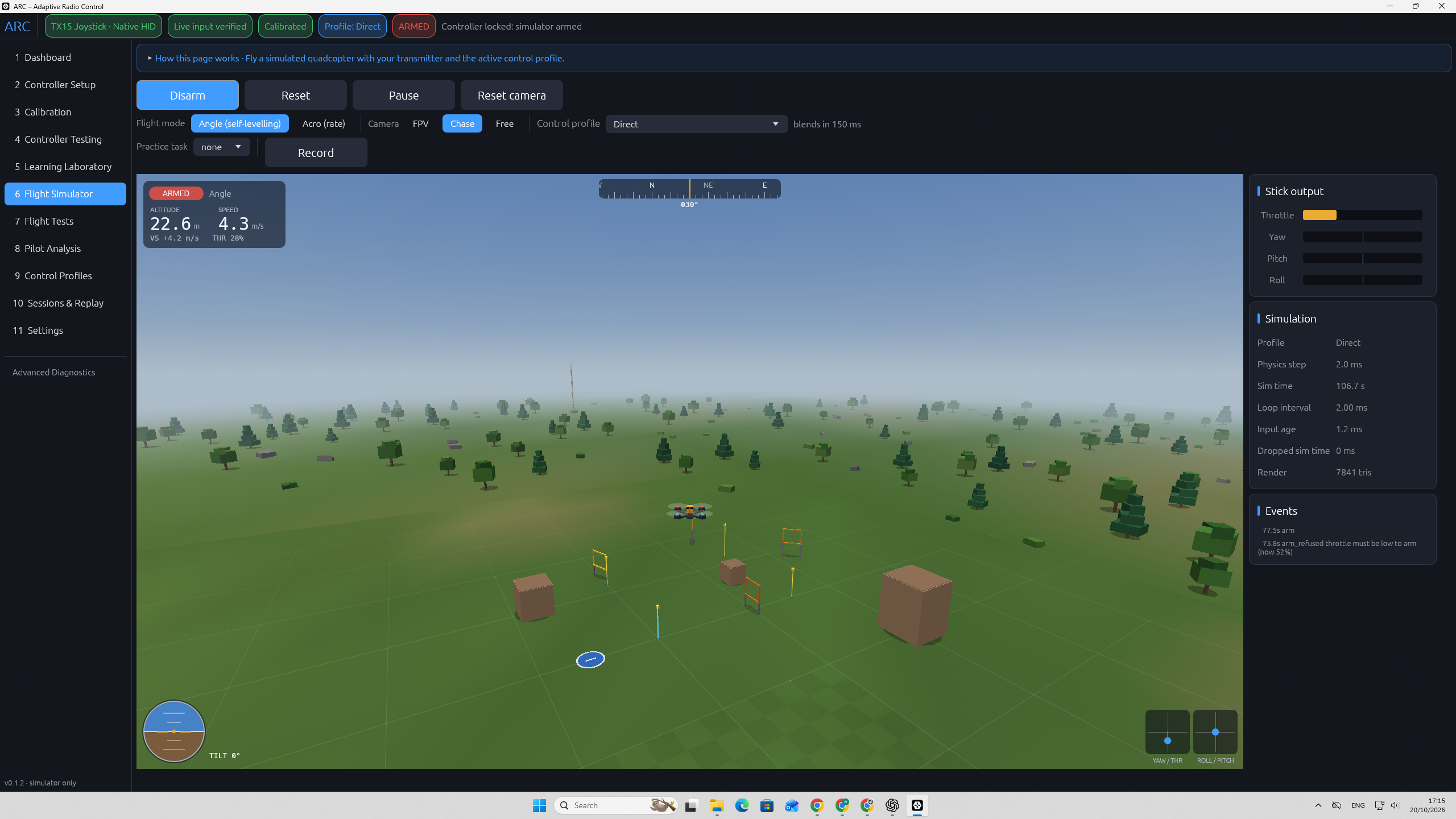
Few screenshots. 1st is the controller testing interface, where inputs from a RadioMaster TX15 are monitored and processed in real time. 2nd shows the integrated 3D flight simulator to experiment with different flight modes and control settings. Still working on learning laboratory [measurements and personalisation]
But when I get in the flow state - I have no idea where I am going to instruct the drone to. Thats the joy you get so locked in that it is zen like time. If the software starts to put me on train rails - then I will not feel the flow.
Honestly, (as seen in the sim times), I am one of the worse/slowest pilots. But it can be done and anyone can learn acro. Its not like automatic braking/acceleration in f1 sim. I am controlling all three axis (and power) at once. Most immersive time I have had with a skill - beats juggling or yoga.
im still trying to figure out the benifit of trying to stiffle personal imputs which are never the same, and on a system where the controller doesn’t know what the pilot is reacting to.
I have a feeling you are looking at fpv in the wrong way. The purpose of acro is to be able to drive (fly) the quad on its limits and your limits. reacting to the environment. how is the controller going to anticipate a gust of wind or having to get out of the way of a quad that suddenly appears coming the other way. It is in these scenarios where you will suddenly want to vere in a direction, and your controller having learned your usual way of flying will stop you from making that move and will cause a crash. FPV is about feeling, i think you have missed it or not discovered it yet as you are fighting something you are not yet comfortable with. rather than this project, if you want to fly better, get on the sticks.