I would of thought it something you would report to the CAA not the police?
CAA have designated the police for anything relative to that.
Aah, OK, I read, in one of the many drone groups that I am in, recently, that someone self reported themselves to the CAA for a drone transgression and received a positive reply.
Ah you can self-report an incident (fly away and violation) yes. Required to do so commercially in some categories.
CHIRP programme etc. Nothing bad will happen. There is/was a form online
1 Like
I’d not heard of CHIRP before. Seems to be set up for ‘whistleblowers’ in the airline industry more than anything else (not in itself a bad idea, it’s just a bit frightening that it is considered necessary), but you could self-report flying transgressions. Not sure what the purpose would be, maybe they give you advice or instruction in how not to repeat whatever the incident was. Useful to know anyway, thanks for the headsup, gnirlS.
Ignorance of the law is no defense right, no matter how silly or inconsistently enforced.
I think his point was that it’s highly likley, like the rest of us, at some point you have done something that isn’t to the letter of it.
Particularly since you said you had a situation where the drone you flew happened to have a guard against that particular violation and so informed you of it. There were likley other violations that weren’t blocked, and that you remain blissfully unaware of.
If you didn’t endanger anyone or anything, I would argue it is a waste of police time and tax payer money to punish you for it, as well as any remote ID exposing you to potential attack vectors in requiring not only your constant tracking but the impossible task of securely storing that data.
Much love but I don’t share your passion for dystopia.
I think what I was getting at was that, of course I break the law, probably every day, the law is complicated and I am simple, even the 5-0 have only got half an idea half of the time. I’m not claiming any moral high ground or trying to be holier than anyone else, but there is, in my mind, a fundamental difference between the sort of unwitting accidental lawbreaking that I and everybody else do all the time, and knowingly breaking the law such as cyclists riding on pavements or ignoring traffic lights, or drivers doing 80 down the motorway. There is further difference between this and going out with the specific intention of breaking the law, such as stealing, hoolignism, fraud, smuggling, premedited murder &c.
Does anyone know the logic for RID on/off?
My Air3s in the UK where it doesnt send RID (i checked) was taken to Europe where its required.
Entered my FRA ID and so on, RID sending quite happily for all flights as it should.
Just came home, did a flight here and checked - its still sending RID. I thought maybe its because the controller needed internet access but ive just tried again with a connection to the controller at the same time and its still sending.
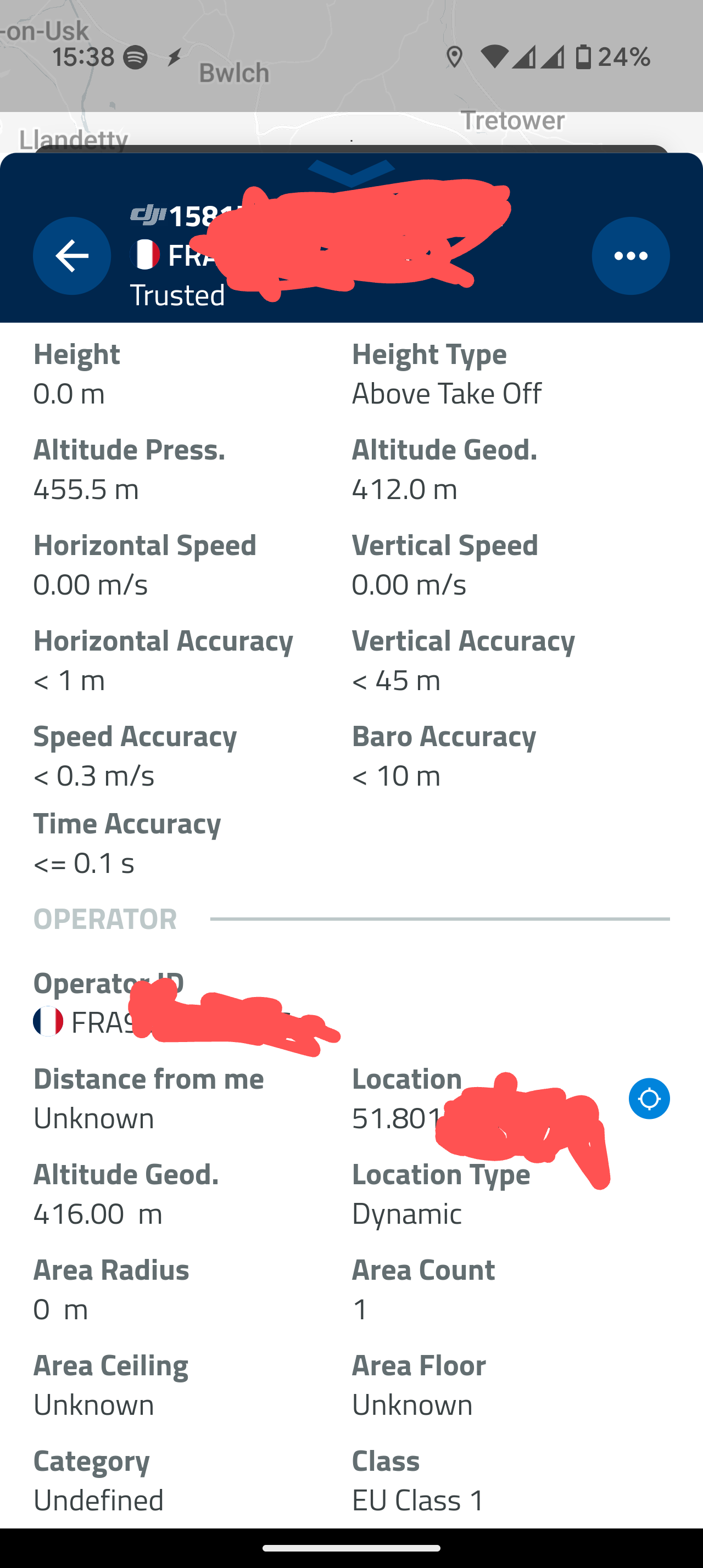
I assumed this was entirely geo-based activation and toggling but it looks more involved. Ive now had 2 x UK flights with RID still happily squawking my EASA ID visible on the various phone apps.
Anyone know the full logic of what causes it to send? Or how to turn it off?
Cant find an edit button but update if anyone needs it - if you remove your operator ID from the Remote ID section it stops transmitting it.
(Abroad it’ll transmit but that field blank where required so different behaviour)
1 Like
Ive activated it in the UK for testing but then had problems turning it off
It seems to need a few reboots waiting everytime for a good gps lock
1 Like
Just done some more testing.
If i delete the FRA (EASA) ID from the RID menu it disables RID transmission completely in the UK.
If i re-enter the ID, it resumes full RID transmission, even in the UK.
Just repeated this 5 times and its the same result.
Abroad where it is required is different - RID is always transmitted but the operator ID field is blank if you havent entered it. But it still sends the rest of the data.
Air3s with latest firmware.
I dont recall the same behaviour on my Mini 3 Pro.
I’ve just read through the entire thread, in search of answers, and ended up with more questions. Firstly, while I don’t like any tom, dick, or karen possibly being able to locate me while I’m flying, I’m not unduly bothered by it and think that RID has potential advantages, so there isn’t much for me in the thread so far.
i have both a flyer ID and an operator ID, and fly a DJI Mini 4K. I would like to ask those more knowledgeable on here (pretty much all of you, then) the following questions, as I have become confused by it all:-
.RID apart, are there any changes im the 2026 rules that affect my drone?
.Under the 2026 rules, will I be able to fly my drone with accessories that take it’s weight over 250g, for examlpe with the propguards fitted? If so, are there any additional restrictions over my current situation?
.I have seen 2 references in the thread to the 2026 rules extending what I believe is my current class of flying to drones of up to 900g. Is this correct or have I misunderstood the new rules? If it is correct, are there any additional restrictions in terms of distance from uninvolved people, buildings, &c?
Apologies for being a befuddled old git!
Your assuming that the proposed rules apply to current drones that we own pre the rule changes - they don’t as the current drones we have are not type / class approved for the new rules so you basically have two sets of rules. One for a set of drones that do not yet exist with the new classification / type approval and the ones that we currently have.
RID is probably quite an important one to consider - I don’t believe (could be wrong) the Mini 4K has any built-in capability for RID
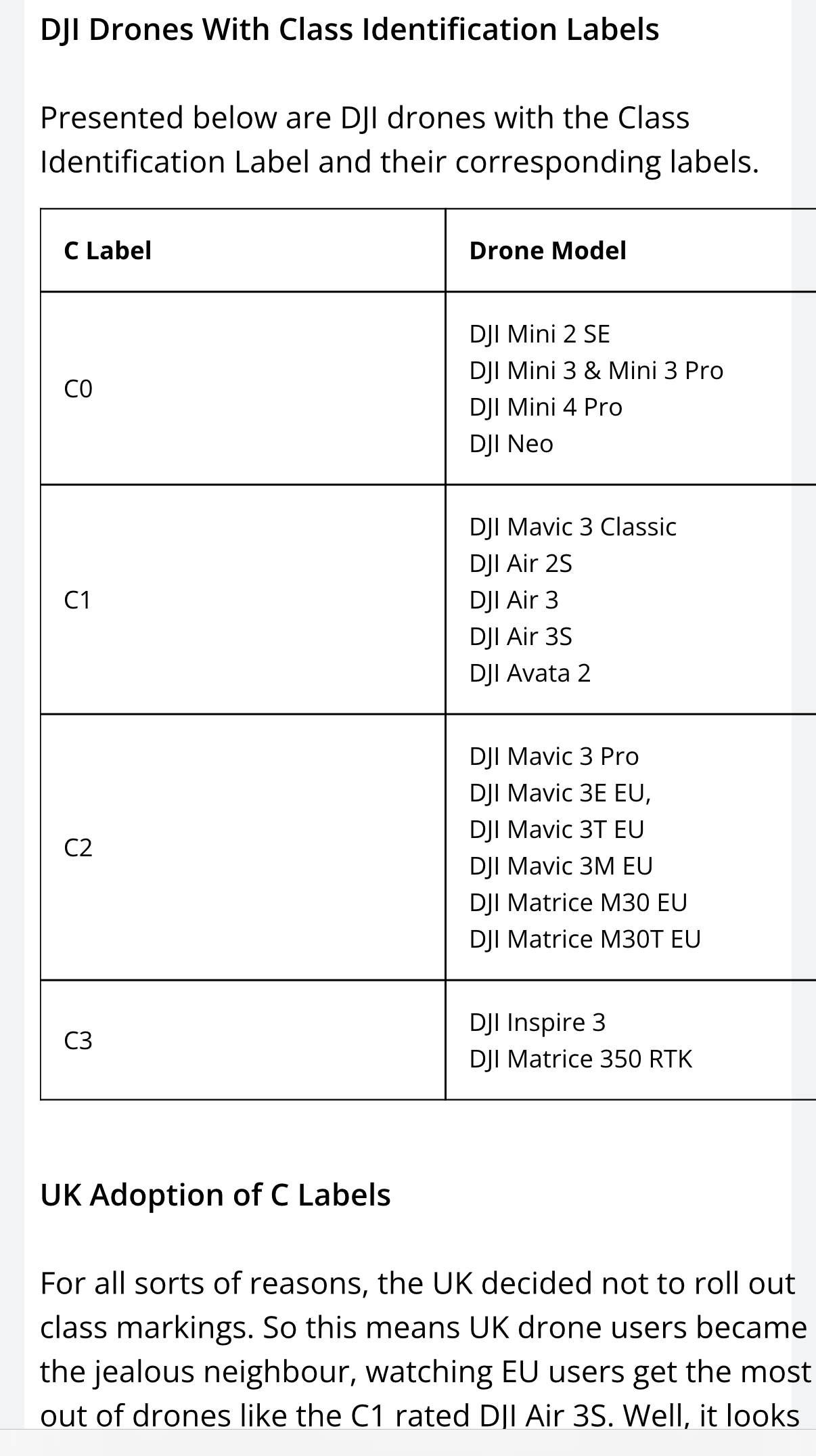
At the moment your Mini 4k is under 250g and has a C0 classification under EASA rules. The proposal is to continue to recognise that C0 and align it with the new UK0 class. But, take it over 250g and it no longer qualifies. So no, you can’t just whack on a load of accessories and still claim c0.
Here’s a consideration for you though. The CAA proposal is also to allow UK1/C1 drones to overfly uninvolved people (effectively aligning UK0/C0 and UK1/C1). You can already apply to have your Mini 4k classed as a C1 drone when flying in the EU so, assuming we can do the same here after 1/1/2026, might be sensible to hop up the class marking since that will allow you to bring the MTOM up to 900g.
Of course, all of this is entirely hypothetical at this stage as we’re only talking about the recommendations and not the actual legislation that will be implemented. Watch this space.
EDIT: As @SparkyFPV just pointed out, I’m wrong on the class mark for the Mini 4k. That being the case, it’s just a sub-250g drone and you’re stuck as is. Which takes us back to the RID problem…
5.13 Remote ID add-on modules: If in-scope privately built and legacy UAS do not have existing Direct Remote ID functionality, the operator will be required to install a Direct Remote ID add-on module on the device. We propose to include the weight of the Remote ID add-on module in the weight categorisation of these UAS, ensuring that the safety of the operation is not impacted by the add-on module. This approach ensures the requirement is implemented consistently across UK airspace.
My reading is that for sub-250g that won’t come in to effect until 01/01/2028, but after that you’ll need an add-on module, which will take you over the 250g and you’re in to the A2 category.
1 Like
Not sure that’s true, only the latest Mini 4 pro has class C0 certification
1 Like
Ah, think you’re right. I’d done a quick check and found an article about them being C0, but they certainly aren’t mentioned on the official EASA listing.
In which case, adding an edit to my last 

1 Like
EASA website says Mini 2SE does as well.
Not only but also the Neo is a C0
1 Like
I was just thinking about the Mini series
1 Like