
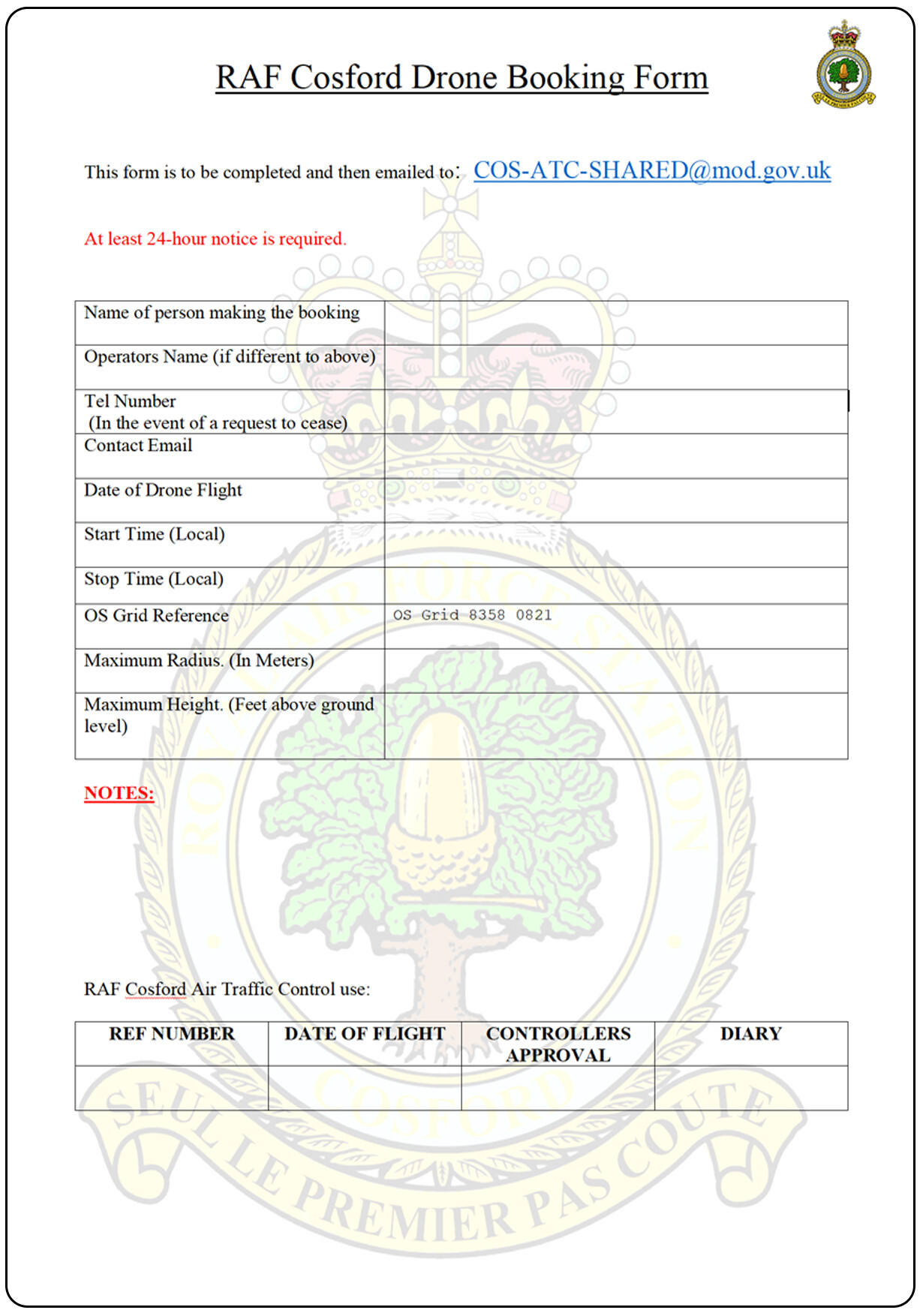
Some of the footage in this video was taken inside a FRZ so I had to get authorisation from RAF Cosford. Cosford ATC is not always manned during the day so you need to request their form by email (form example with email address in it below), complete it and return it to their email address 24 hours prior to your intended flight. Moreover, they do not check their emails Thu or Fri as they work the weekends, therefore you need to take this into account.
I submitted my form and it was accepted, however, when I subsequently thanked them the day after the flight I was made aware that I had put the month of November on the form instead of October by mistake…Doh! They were okay about it thankfully and we were able to have a laugh over it; I’m seeing my GP next week (or is it next month 
 ).
).
THE HOUSE THAT SAVED A KING: WITH NARRATED HISTORY AND DJI AERIAL FOOTAGE.
Boscobel House is a grade II* listed building in the parish of Boscobel in Shropshire. It’s been, at various times, a farmhouse, a hunting lodge, and a holiday home; It’s renowned for its role in the history of the English Civil War and the dramatic escape of King Charles II after the Battle of Worcester in 1651.
Boscobel is on land which belonged to White Ladies Priory in the Middle Ages, and at that time it was extra-parochial. The House was created around 1632, when landowner John Giffard of White Ladies Priory converted a timber-framed farmhouse, built some time in the 16th century, into a hunting lodge.
The priory and its estate, including the farmhouse site, had been leased from the Crown by William Skeffington after the Dissolution of the Monasteries. It passed into the Giffard family after William left it to his widow, Joan, who subsequently married Edward Giffard, son of Sir John Giffard of Chillington Hall. The reversion was sold in 1540, but was re-purchased later, and subsequently passed on to Edward’s heir, John.
John Giffard decided to make the farmhouse more functional by building a substantial extension to the south, including a living room and bedrooms that were more in keeping with those enjoyed by the gentry, and he renamed the new hunting lodge Boscobel House.
The Giffard family were recusants who refused to participate in the worship of the established Church of England. For them, this brought fines, imprisonment and discrimination. The Gifford’s took care to surround themselves with reliable retainers; until the mid-19th century, after the Catholic Emancipation. The house itself was used to shelter Catholic priests, hiding them occasionally in at least one priest-hole.
This secret function of the house was to play a key part in the history of the country. It was here that Charles II hid in a tree to escape discovery by Parliamentary soldiers after his escape from the Battle of Worcester. During his six-week flight, he passed through numerous English counties, and was forced to hide in one of Boscobel’s oak trees in the grounds of a house that was being searched by Parliamentarian soldiers. Although the original Royal Oak in which King Charles II hid was destroyed over time, an oak tree grown from one of its acorns stands on the estate today. The tree has become a national symbol and an enduring emblem of loyalty to the Crown.
Charles was moved from Boscobel to Moseley Old Hall, another Catholic redoubt near Wolverhampton, and ultimately escaped the region posing as the servant of Jane Lane of Bentley, whose family were also landowners of the nearby Broom Hall.
The local Catholic Penderel family also played a significant role in aiding King Charles II’s escape. They provided food, clothing, and shelter while helping him evade capture. The Penderels’ loyalty is commemorated in history as vital to the survival of the monarchy.
The estate and Boscobel were sold to Walter Evans, a Derbyshire industrialist, in 1812, although the Fitzherbert family retained the White Ladies Priory site. It was the Evans family who restored the house and gardens, and promoted the legend of Charles II. A substantial farm building was appended to the northern side of the house in the 19th century, making three distinct wings. It was sold to Orlando Bridgeman, 5th Earl of Bradford in 1918, who placed both it and the infamous tree in the hands of the Ministry of Works in 1954. It subsequently passed via the Department of the Environment to English Heritage in 1984.
To the south are the formal gardens, featuring a parterre hedged with box, restored in recent times in the approximate area of a box garden shown in 17th-century views of Boscobel. On its south-west corner is the Mount, a mound topped by a modern shelter, where Charles spent the day reading.
The Royal Oak stands about south-west of the house, in a farmer’s field and is believed to be a direct descendant of the original tree used by Charles. It has been surrounded by iron railings for many decades, but an outer wooden fence was added to protect visitors from falling timber after major cracks appeared in Autumn 2010. Another oak sapling grown from one of the Son’s acorns was planted in 2001 by Prince Charles.
Drone Scene Entry: Where can I fly my drone in the UK? - Boscobel House and the Royal Oak, Brewood, Staffordshire - English Heritage in West Midlands
Hope you anjoy it and thanks for watching. I have more content on my YouTube Channel if you liked this sort of stuff:
@DocColVideo.


 need coffee …