cap3297-annual-safety-review-2025.pdf (928.0 KB)
Page 23 on for drones. The number of reported incidents seems to be going down each year …
cap3297-annual-safety-review-2025.pdf (928.0 KB)
Page 23 on for drones. The number of reported incidents seems to be going down each year …
Good read, thank you for sharing.
That’s good news as I’m reading it then; 31% annual increase in registrations against a 9% fall in reported incidents means that, overall, we are getting better at not crashing! We probably are, but the real situation is of course more complex than that; not all the registered pilots/drones are flying all the time, and the incident figures are only those reported; one suspects that a good many are not! Because a) the pilots are a bit ashamed of themselves and b) possibly been flying ‘differently legitimately’ and don’t want to open themselves to possible legal or civil case action. But figures that definitive seriously suggest that incidents are decreasing despite a fairly well accepted increase in drone usage are A Good Thing, achieved against a probable background of 95% of us flying BVLOS 95% of the time, but don’t tell anyone… The CAA aren’t stupid, they are fully aware of this, but seem to be going with a ‘blind eye’ (blind eye, BVLOS, see what I did there) so long as we don’t abuse it and behave ourselves. Possible future changes to the regs may will allow BVLOS in specific limited circumstances and locations for those certificated, and this will only be a formalisation of the real on the ground, I mean in the sky, situation, but that’s only my opinion, don’t take my word for it!
There are solid reasons for this. Overall, pilots are becoming more experienced (against which newbies are taking the hobby up, and are a risk in the early days), and one would hope better educated/informed. And drone tech is improving, which has an impact on safety; the Mini 4K I was flying a couple of years ago did not have OA, and the Lito 1 I’m flying now has this feature, as well as longer battery life and better Occusync. all of which have to feed into it being a safer fly (especially as my innate cynicism means I don’t like relying on these features)!
One might get an impression from our balanced, always truthful, and by no means sensationalist media that ‘more people are flying drones irresponsibly and problem use is increasing’; these figures suggest that more people are indeed flying drones but that problem use is decreasing. Detection of drones in FRZs is quantum better than it was in the dark days of the ‘Gatwick Incident’ but there are still unsubstantiated reports of drones flying well above 400’ agl. My personal view is that any drone reported by an airline pilot, airport security, or police, is actually a plastic bag or a balloon, but you have to allow the possibility that some of them are drones. Military airbase incursions over European NATO bases are different, and almost certainly hostile action from a ‘certain power’ (let’s call it Russia, mainly because it’s Russia…).
But, good news, and there’s not much of that about deze daze!
Who me, never.

Pretty much!
Really? Where’s your evidence for that? Don’t be tarring the rest of us with such suspicions, based on what you might do John. Many of us follow the code and are perfectly legit… …way more than 5%, anyway.
Back atcha, Little Red; where’s your evidence for that. I’d say most of us try to follow the code as best we can, but following VLOS in it’s strictest interpretation is not far off impossible! VLOS ‘at all times’, being able to clearly see not only the drone but it’s orientation and heading without consulting the screen, in bright sunlight and glare, with only momentary glances away from it at the screen? I can lose sight of my drone in some lighting conditions when it is only 20’ away (which is why I’ve prettied it up with hi-viz reflectives and a strobon), and struggle at more than about 150-200’ even in good lighting. I actually think I am safer if I refer more often to the screen, especially the height/distance and the live map, but still try my best because I am by nature a law-abiding sort of cove…
These discussions (especially their less well-informed versions on the book of face) often degenerate into ‘how often do you obey the speed limit in your car’, which is a good analogy. Back in the days when I drove a car, I did obey the speed limit fairly strictly, but that’s by the by; I was well aware that I was pretty much the only one that did most of the time! Solid and plentiful evidence, anecdotal and actual from footage put up online shows that the huge majority of drone pilots very frequently fly at ranges well beyond where thye can properly see their drone, and I mean by the CAA definition of orientation and direction of movement, not just a speck in the sky! 95% of us 95% of the time may have been egging it a bit to make my point, but your ‘way more than 5%’ is just as unsubstantiated and eggy.
Is this important? Well, it’s a CAA rule, part of the drone code and a legal requirement, so, yes. On the other hand, do the CAA themselves chase it up? No, they don’t, not as a standalone ‘offence’ unless it involves flying well beyond VLOS, like miles, which one does hear of occasionally. Who would report such flying, and how would the CAA prove their case if it came to a prosecution? Presumably they’d use flight data, which records the distance from home point, and I’m assuming (because I don’t know definitively) that they have access to this from DJI (other manufacturers are available, it is alleged). The CAA, rightly in my opinion, are much more concerned with transgression of the 400’ agl (all right, I know agl isn’t a strictly correct definition of this rule, it’s ‘from the ground’) and NFZ/NOTAM boundaries. Pilots who do not conform to these are potentially risking lives, and airspace safety is very much the CAA’s concern!
Having been ridiculed online, including here, by the ‘just fly it’ brigade, and having pretty much lost my battle with being able to reliably see my drone in anything but the most favourable lighting conditions at any sort of range, I have adopted the approach of risk-assessing each flight individually by two criteria. Am I going to be likely to endanger anyone, or damage their property, or am I going to be likely to lose my drone? In order to reduce those risks as much as possible (this is the real world, you can never completely eliminate them), I fly in the following way:-
.High and in empty airspace, away from anything that I can collide with. This is not always compatible with good, clear, VLOS on the drone, but is I feel important. Above the treeline, above any powerlines or other overhead obstructions. This also ticks the ‘nuisance’ box; nobody can hear it up there and few will even be aware of it’s presence unless they are other pilots, or birders.
.If I need to consult the screen, it will take more than a brief glance, so I leave the drone in a hover before I do it. This means that I know where it is when I want to restore my VLOS relationship with it, and that I don’t get into any further trouble while I am doing so.
.If I want to get close up to anything, or fly lower down where there are obstacles, even when they seem to be a good way off, I fly with great care and at low speeds. As I use the zoom feature a lot, the impression of imminent disaster this sometimes gives me can be an extra safety buffer, but you need to be aware of your surroundings. As an example, earlier in the week I did some footage of the Newport Transporter Bridge, a sort of big coat-hanger across the River Usk lit by the afternoon sun on it’s ‘downstream’ side. This has a National Grid powerline river crossing just downstream of it about 50 yards away, and I was very concious of the proximitiy of those pylons and cables out of camera view while filming, and nervous in consequence. I had the drone in VLOS the whole time, but the very zoom feature that led me to believe I was closer to the coathanger than I actually was was obscuring the fact that I was closer to the powerlines than I wanted to be; the value of VLOS as opposed to screen flying! As I said, it is a matter of balance and safe practice/keeping clear of things. Fly in the middle of the sky, the edges are where the collisions happen!
Only one drone-loss in 3 years (gull-mobbing, not my fault) but a few near-misses and minor crashes early doors. The above ‘Johnboy code of practice’ has led to more relaxed and, I contend, safer flying, but I have had to make a sort of deal with myself in which I do not obsess about VLOS and, if the circumstances are favourable, might even wilfully ignore it (over open water for example, where the risk is only to me, of drone-loss, and I am prepared to accept it). Not always conducive to relaxed flying, especially when you check the distance and realise that you are perhaps a quarter mile beyond what you estimated (!!), but about risk-assessment and reasonable expectation. I very much doubt that the CAA will ever chastise me for this blatant and unapologetic scofflawry…
You are free to criticise this behaviour, Little Red, I’m not a saint and I’m not the drone police. It’s a flying regime that works for me, and for now I will continue to adopt it! VLOS when I look up, but mostly referring to the screen, and I would be fairly willing to bet that most of us fly something like this even without being overtly aware of it. Next time you’re flying, turn the screen away from you and see how long you last without turning it back to consult it! I have set height limits of 390’, a 10’ safety buffer for the Code limit at which I can just make out the drone or the Strobon, and 500’ range; in fact, I rarely exceed half that distance…
Let’s postulate a situation in which I could reliably see my drone at, say, 3 miles range (the FAA requirement for strobes for night-flying). This could presumably be achieved by FAA-compliant lighting, but in practice would be unlikely with the lighting mounted on top of the drone and focussed upwards to be visible to other aircraft. In the first place, other aircraft should be high enough to be out of drone/uav airspace anyway except in FRZ/NOTAMs and in the second, I’m in the UK. The light would have to be either powerful enough to burn retinas and hence a danger in and of itself, generating potenentially drone-damaging levels of heat, or so finely focussed as to be to all intents and purposes useless for drone-locating, something like a laser! The power source for a laser is too heavy for a drone, especially a Mini/Lito/Neo/Flip. And it doesn’t allow you to determine the orientation of the drone. The screen, however, can do this! My opinion, (others are available but i cannot guarantee their quality) is that there is no real solution to this beyond using the screen. The CAA seem to be moving towards permitting BVLOS without spotters with limits on the actual distance and type of airspace, possibly involving extra pilot certification and possibly lower altitude limits, which would resolve a lot of this and is, I submit, the right direction to be heading in as drone-technology, detection, and OA improve.
So for those oldies, how did we do it before screen controllers or phone apps?
TLDR; but feel free to organise a poll
I wasn’t involved then, but I suspect that, if my experiences of watching model rc aircraft are anything to go by, you mostly crashed… Chum of mine used to send an old iPhone up clamped to an old Inspire or similar and get good footage, but he is both a very highly skilled pilot and an equally skilled cinematographer. It was a big drone and easy to keep eyes on. Even he lost a couple of drones and phones!
And. of course, the regs were different, and I’d need to be ejjermerkaterised in what they actually were before commenting! Which would be interesting, but irrelevent to a discussion about the current situation!
I sort of became aware of drone regs long before owning a drone, in the faff following the ‘Gatwick incident’, which I found to be amusing spectator sport for it’s obvious misreporting and as an example of the high standards of British journalism (high meaning ‘probably on class A drugs’). Firstly, we were expected to believe without question that hobby drones were capable of flying in one of the worst storms for years, and that their batteries were capable of maintaining continuous flight for several continuous hours, and that the lights in the sky seen by a security guy could only possibly have been from drones in what is probably the busiest airspace on the planet. I want a drone that can fly like that… Not rocket science to realise that all of this was grade A bollocks, but it was fascinating to see how the meeja reacted to it and how the public at large swallowed it! The situation then descended into sheer farce, with the police reporting their own drone the next day, and a classic ‘usual suspects’ arrest and detention of a local couple who were known to be ‘into model aircraft’, an object lesson in how mass hysteria can gain a foothold and be spread that the residents of Jersey could have benefitted from a few years later! As I recall it, this and the public anti-drone outcry that ensued was what resulted in the CAA introducing FRZ around airports, and other sensitive locations, and, I assume, other regs such as the 400’ away from the ground rule. But not until I came to actually owning a drone 3 years ago did I seriously investigate the rules and start to consider how I could best fly within them.
Exactly the same, if not stricter especially around people
We tried to avoid that, pound for pound they were a lot more expensive back then
Interesting to know; of course, the regs referring to proximity to people (and buildings?) were tighter before the ‘249g’ ‘mini’ category (this is what I fly in) were brought in, but I hadn’t considered how they might have applied to VLOS. ‘Mini’ drones are, I suppose, part of why the debate about VLOS is so often aired and repeated; if the drones are physically smaller, they must be harder to see in any given situation! The answer is possibly brighter lights, but that brings it’s own problems.
If you couldn’t see it how did you ever expect to get it back
That BBC article is interesting, both in terms of what has changed and what hasn’t. The point about steel, carbon fibre, and aluminium being ingested into an aircraft engine seems less relevant in a world where sub-250g drones and props are made from thin crunchy lightweight plastic, not that throwing them into aircraft engines is a particularly safe thing to do, but it has to make the idea of an amateur-piloted drone bringing down an airline less likely… Still not safe, though, and the 400agl limit is still needed as are airport FRZ, and as I reckon they always will be!
Not only were the drones more expensive and the whole game more of a rich man’s hobby, but I suspect more of them were home-made as well, which must have had safety implications. I would never be happy flying anything I built myself, not that I doubt my ability to do so given decent quality components, but because I do not have access to the sort of quality control or safety testing that DJI et al have!
Not so much 2015 was my introduction, DJI Phantom 3 (about £800 if i remember) and then when they introduced the Mavic Pro in 2016 the game changed massively (hence the drone code)
I’m still astounded when I see people who cannot fly line of sight, they shouldn’t be in the air frankly.
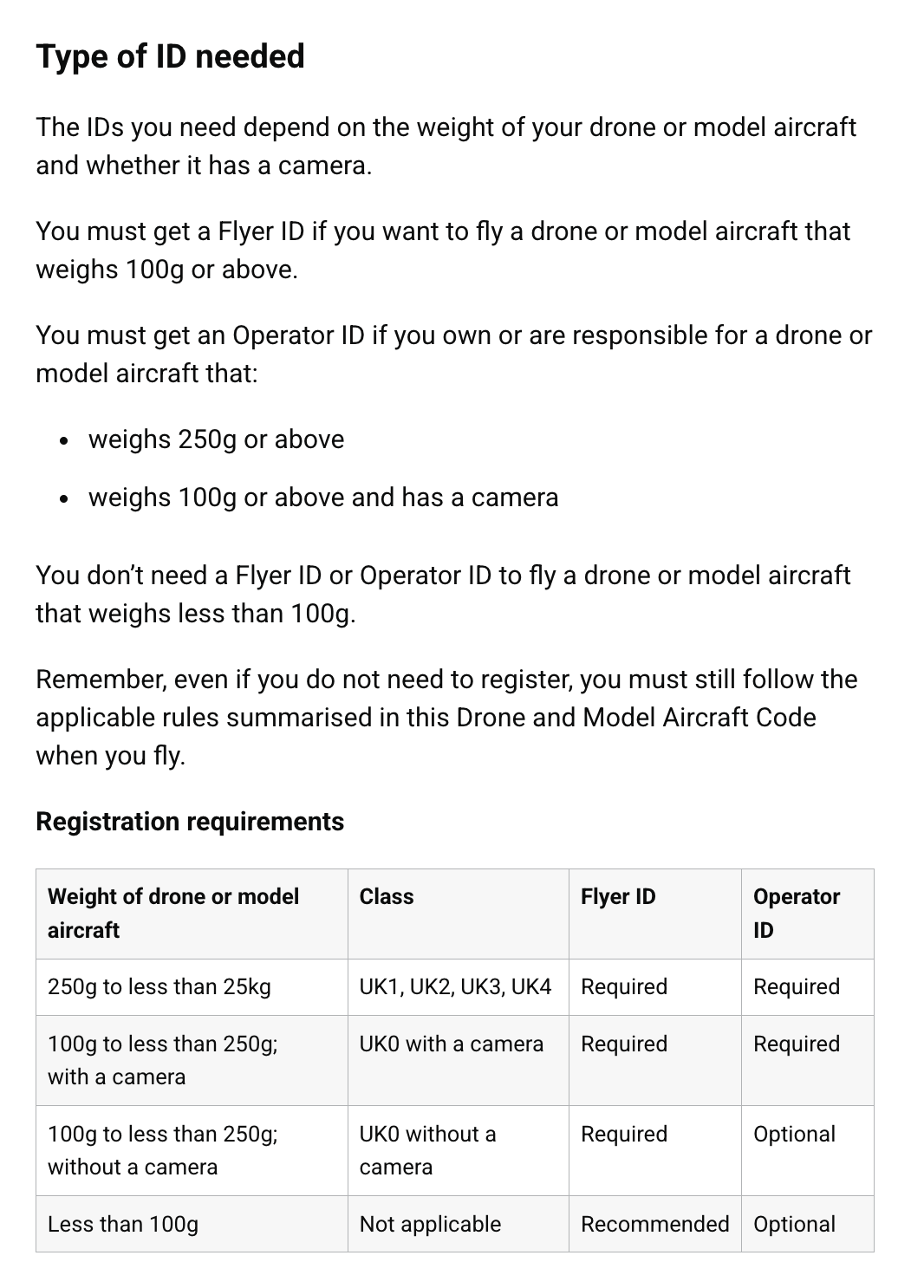
It looks like they don’t understand their own registration requirements,
We all know that a Flyer ID is required to obtain an Operator ID.

I thought you could get them independently. When I took the Flyer ID test one of my questions was over a family who wanted a drone. They said that there was a mother and two children aged 14 and 17. It said that the mother did not want to fly but her kids did. It asked who would be the operator and who would be the flyer. I selected the option for the mother to be the operator and both children to be the flyers. I got the question right. An Operator must be over 18 and they are responsible for the drone. The Flyer is the person who flies it and can be over 13 years old, but they don’t need to be the owner (operator) of the drone.