I have mini 3 drone 250g. I only normally fly it less than 25m high and around 1-2km.
I am confused on restricted areas. Does all the restriction apply if I am flying under 25m high as the maps are very confusing. Thank in advance for your suggestion and comments
1 Like
If you’re happy flying 2km away, why are you worrying about any of the other rules?
14 Likes
As your drone is over 100grms you should have a Flyer ID which is free from the CAA but you must pass their online test based on the Drone Code. The Drone Code together with the test will make sure you understand the rules you need to follow to fly your drone legally.
2 Likes
Sorry that was flippant…
I’ve never seen a restriction that applies to SUAVs that doesn’t start at surface level. So yes, they’ll still apply to you at 25m.
The information on Drone Scene is pretty clear.
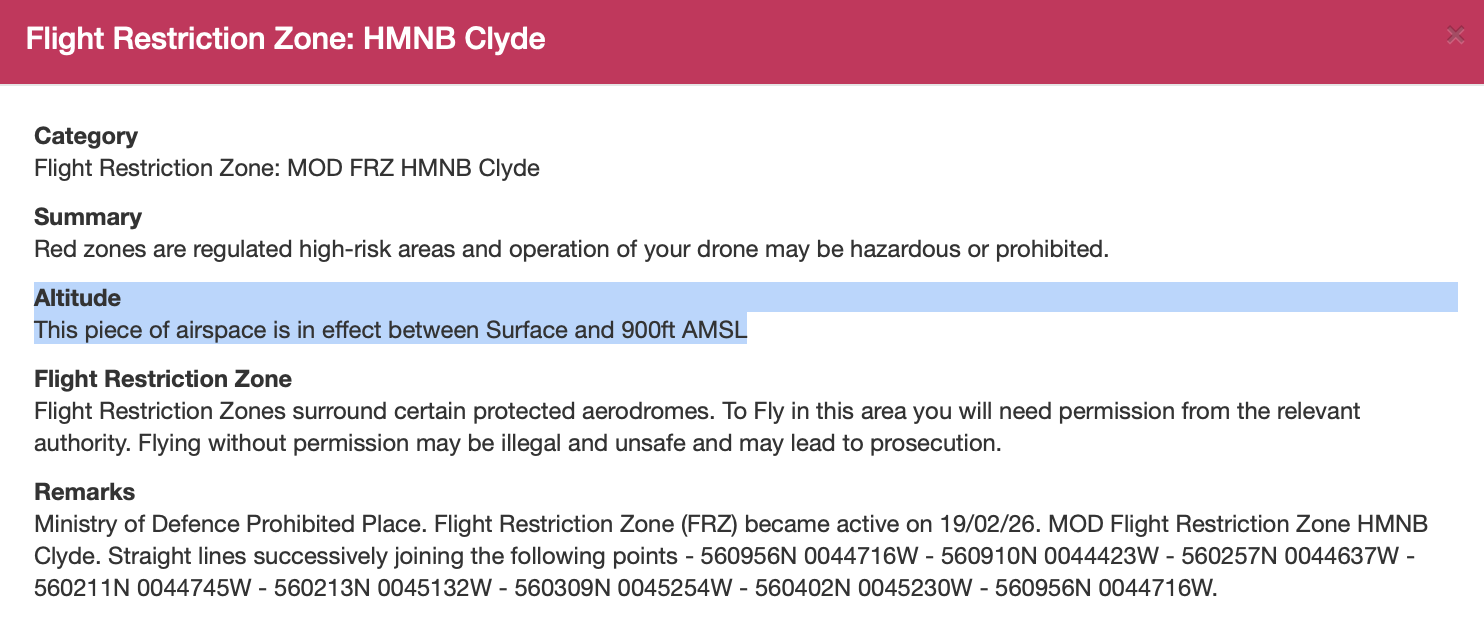
In this example the restriction states that it starts at the ‘Surface’.
The only slight confusion is that where there’s a figure they’re measuring in 100’s of feet. So in this screenshot, “900ft AMSL” means “90,000ft AMSL” (above mean sea level).
My comment on you being happy to fly 2km away is because you have to keep your drone in visual line of sight (VLOS) at all times - which means you need to be able to see it with the naked eye clearly enough to know which way it’s facing.
Most people can’t maintain VLOS of a mini-style drone beyond a few hundred metres. Best will in the world, there’s simply no way you’re keeping it in sight 2km away.
As @Jhdee says, you should have your FlyerID, which means you had to pass a test of your understanding of the Drone Code. VLOS is basics.
5 Likes
In case the FlyerID is new to you, Jay, you can find details here. The links down the right side of the page cover what you should know.
1 Like
Maybe have a quick read on vlos reg?
Unless you mean flying in follow mode ofc. ;p
2 Likes
2km! I can’t see my drone barely 50m up in the sky sometimes!
Look at good 2 go.
2 Likes
I should have explained better in that I have set max distance to 2kn and heigh to 50m.
But thank you for your suggestions and comments. I have gone to CAA and pass the test and got the necessary cert. It sounds like it doesn’t matter what height or distance use the restriction maps to check the area.
2 Likes
Hi @jkpatel01, it looks as though you’re quite new here 
Why not nip over to the Introductions category to say hello and tell us a bit about yourself 
1 Like
Reading your comment here I can’t help but conclude that you don’t understand “something” correctly.
The phrase “It sounds like it doesn’t matter what height or distance…” is very wrong.
It really does matter the distance, and it is explained in the drone code very clearly that you must keep the drone close enough to you that you can clearly see it and which way it is facing, and that you cannot go higher than 400 feet from takeoff.
I am hoping that this is more down to English not necessarily being your first language and that there is just a mixup in the comprehension between your keyboard and my eyes.
1 Like
Basic rule of thumb i use to explain vlos to people
At all times you must be able to safely return and land your drone if the screen decides to pack up and stop working without using any automation ie Return to home.
I’ld be interested how you guys feel about this.
I did read somewhere ages ago something about rth functions being prohibited under some circumstances or situations? Not sure if this is still current.
Edit. Emergencies only and no waypoint missions flying under article 16?
3 Likes
I think that’s a good rule of thumb to determine VLOS compliance 
1 Like
I also analogise
Flyer id L plates
A2 C of C Full driving license
Gvc or the new thing. HGV license.
Helps the muggles relate, i find.
2 Likes
Imagine being able to get your drivers license with no evidence you’ve ever driven a car
Cancel that I’ve seen a few that can’t drive 
1 Like
Drone Code is a)Law, and b)very good advice. The basics are:-
.Fly no higher than 400’/120m away from the ground, usually expressed as ‘above ground level’ (agl), which is not the same as ‘above sea level’ (asl) and might be an indeterminate height agl within 400’ horizontal distance of a vertical cliff face. This is beacause manned aircraft are required to fly at a minimum of 500’ agl, unless they are taking off or landing from an airport or similar. This maintains a safety buffer between ‘us’ and ‘them’ of 100’. The CAA are, rightly, pretty hot on this, Air Traffic Control will detect & monitor your drone, and you 'will get a knock on your door from some large and angry people in large and angry uniforms.
.Do not fly in restricted zones, shown in red on flying maps. That is, airports, some military/secret squirrel, firing ranges, nuclear power stations, prisons, royal residences. You can fly with permission in Airport FRZ, by arrangement with ATC, there’s an online form and they need a few day’s notice.
.Learn how to read NOTAMs, shown in blue on flying maps. These are Notices To Airmen, and are temporary restrictions or warnings. You need to click on the area to bring up details of the NOTAMS, the dates and times it is in force for, the liwer and upper altitude limits that apply, and the reasons for the Notice. This information can be technical and a bit dense, and not all NOTAMS apply to drones all the time. You are somtimes fiven a number to ring for further details.
Learn the purpose of Hazard warnings, ahown in yellow on fkying maps. Like NOTAMS, they will reveal details and reasons when clicked on, but are advisory and you can fly over them, but need to be aware of feature to avoid and the needs of animals in SSSIs. Basically, keep high, don’t buzz tge nesting birds, and you’ll be fine!
Ok, that’s flying taken care of, but worth mentioning that airspace in the UK is managed and controlled by the CAA, not landowners on the ground so most ‘no drone flying onbthe ground’ notices are meaningless. TOAL (Taking Off And Landing), however, does need permission from the relevant landowner and is considered trespass if this permission is not given. This leads to the situation where you can legally TOAL from public ground outside a National Trust property, or a reservoir, or Forestry Commision where TOAL is not allowed and overfly it, and many of us do! This is the reason for the ‘better to ask for forgiveness than permission’ comments; usually, if you ask, you will be told you can’t fly, so it is mostly better to fly and deal with challenges if they arise. The reality is that, most of the time if you are at a readonable height and your drone is out of earshot, nobody on the ground will notice it!
At all times you need to fky to the Drone Code, so with consideration and respect for the privacy, general needs, and safety of those on the ground. NEVER, EVER, fly directly over dense crowds and be aware of any noise or visual intrusion. Don’t attach things to your drone that contravene the manufacturers’ instructions, which will usually take tour drone over it’s weight class. Don’t use those ‘droppers’ available online and marketed as romantic delivery systems for flowers or chocolates; I cannot imagine anything more dangerous than something hanging off your drone to get entangled in trees or phone lines, or less romantic than taking your girlfriend’s eye out from 80’ with a thorny rose…
VLOS, Visual Line Of Sight. You (or a spotter standing next to you) need to have an unobstructed line of sight view of the drone AT ALL TIMES while it is in the air, and the CAA’s definirion of this is that you must be able to see the drone (prescription glasses are allowed, binoculars are not), and to be able to see which way it is facing as well. The actual distance will depend on how big your drone is, the lighting conditions, and whether it is above or below the ‘skyline’ from your position, and how goid your eyesight is, so this is not a definitive fixed distance.
1 Like
You could have saved all that waffle and just posted the official link to the CAA Drone and Aircraft Model Code. It’s very self explanatory to anyone. 
6 Likes
It’s not a perfect analogy but yeah..
Try driving through london ;p
It’s neither.
It’s the CAA’s plain English summary of the law, not itself the primary piece of legislation. The law is contained in things such as the Air Navigation Order 2016 and the UK versions of Regulation (EU) 2019/947 and 2019/945. These are legally enforceable.
As for very good advice, Its hopelessly out of date with the capabilities of modern drones. But it is what it is.
3 Likes
No, I think it’s still pretty good as overall advice for beginners. You have a good point about the abilities of modern drones, but it is still good practice to keep eyes on, for example, and it is never a good idea to fly over crowds! There is a danger in the idea that modern drones can be flown without reference to The Code, but I think some relaxation of the VLOS rule will be forthcoming fairly soon; rc connectivity and OA are more than capable of it. It will, I suspect, require new pilot certification and be restricted in range, though; the days when I can fly out several miles and do tricky manoevres to get shots, then return, are a long way off yet!