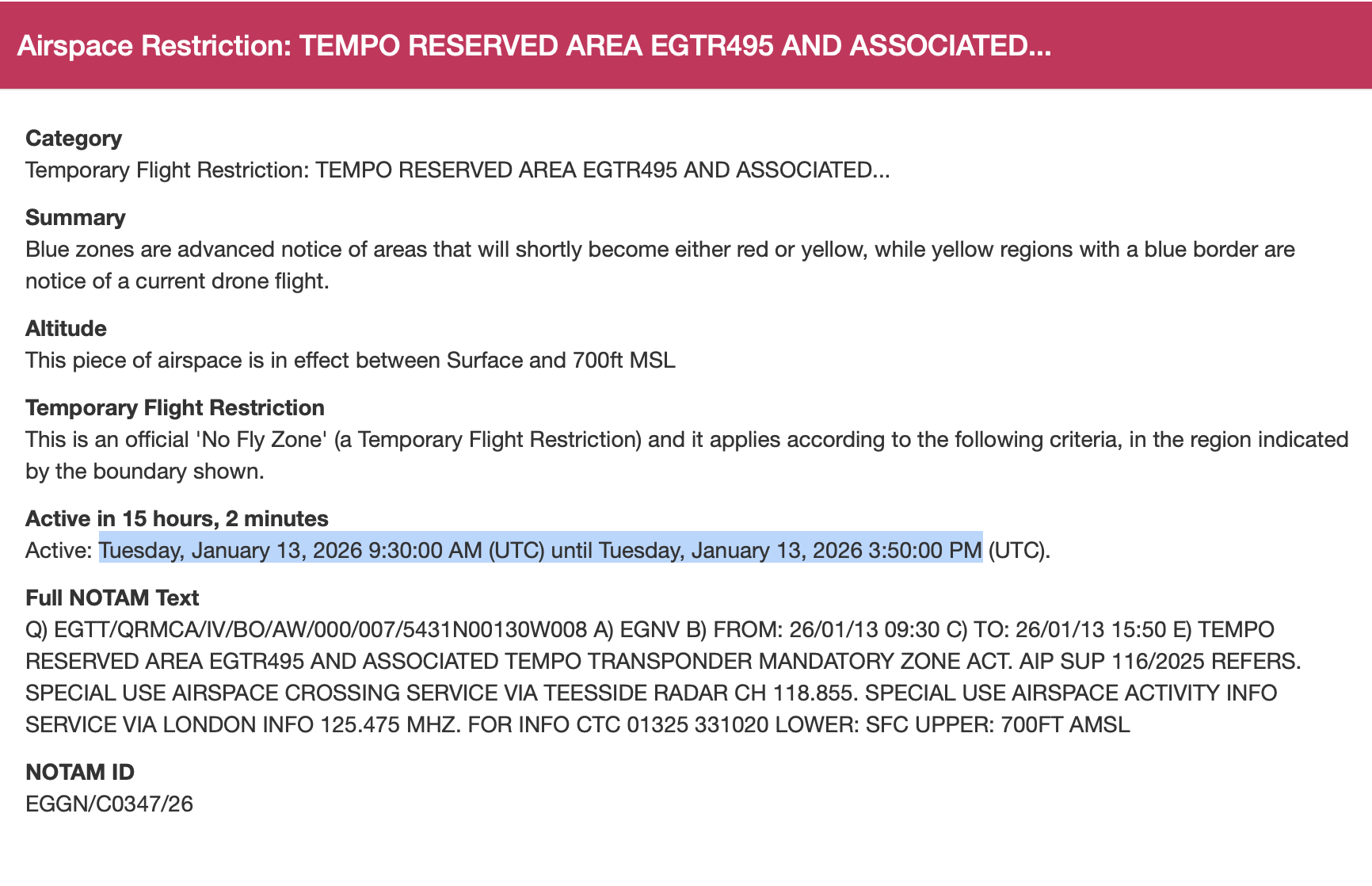
Drone delivery testing has started today in Darlington and Drone Scene shows a large red temporary no fly zone. I wonder how this will affect drone flying when the whole country is using this delivery method.
Sorry I should have said Drone Assist
Drone delivery testing has started today in Darlington and Drone Scene shows a large red temporary no fly zone. I wonder how this will affect drone flying when the whole country is using this delivery method.
Sorry I should have said Drone Assist
Interesting point. I can’t imagine no-fly zones being the norm after testing - it’d cause all kinds of issues, including with any rivals.
Amazon’s blog post on it states that the MK30 drones can recognise other airborne vehicles - post
Tech like the Remote ID will what aid in ensuring the safety of these type of drones so they know what is in the sky. More aircrafts will have to also broadcast their location too and as such the need for no fly zones won’t be as much of an issue as the drone code already has a lot in it to ensure the skys are safe for all.
Just need to push home to the people that think VLOS is a bit of a joke that there is very much a need to know where you and others are in the sky.
Overall, yes it will have an impact on the hobby - but it wont be a massive one. Just needs more education /awareness.
I suspect that it won’t impact us any more than the ever-present expectation that there could be low-flying helicopters anywhere we’re flying. By the time drone deliveries have become common enough to trouble us our own drones are going to have evolved so much that the way we fly now will seem utterly bizarre.
And I wouldn’t worry about the Darlington testing - the temporary no fly zone is VERY temporary:
If anyone is bothered, the local rag
Well, yes, but a low-flying helicopter, even a small one, is big and noisy enought to make it’s presence felt at the sort of range that we need to be keeping to to conform to the VLOS requirement. Delivery drones are smaller, and may be less easy to see, especially when they are returning to base without a load being carried. Quieter as well, at least I’d hope so!
It should be possible to see them at VLOS range all the same, but how are we to judge their size, and thus distance from us, against a sky background, and especially at night? Will we be able to hear them? We will, presumably, be expected to keep out of their way and since they are authorised to fly BVLOS, need to keep a close eye on the immediately local airspace!
The sky is getting busier and avoidance technology will need to catch up to be effective with moving objects. In the meantime, take care up there, ladies & gentlemen…
There could be more to it than we think. Why the hard limit on mini drones to 120 metres? This hard limit could be coming to a wider range of consumer drones to clear airspace for deliveries. Money talks and commercialisation of sub 600ft airspace (for example) could impact freedoms for hobbyists. Personally the airdrop idea seems daft to me, except for things like blood or emergency supplies to hospitals.
Look at the article above, they’re pretty massive
The user case for these things is quite small - home deliveries is a bit crazy really and I very much doubt we will see them being used for this for quite some time here in the UK as gardens are just too small and we have loads of obstacles around our gardens - we all know how much tree’s love drones haha - but for blood / test kits etc between hospitals or urgent parts between buildings will work well. There is a lot of hospitals in Africa using drones ( they are fixed wing units ) to get meds to remote places.
For the UK it will be more mail runs to islands like what is currently being done with the Royal Mail.
In the US they ( Amazon ) do home delivery but they have massive gardens with open spaces to do that and its also quite a distance between fulfilment centres.
And your right to think that the CAA are looking into commercial zones of the airspace for this and also ensuring its just safe for all to use the airspace. Money money money !
Mate go and have a look on YouTube for Zipline Delivery drones / Wing Delivery drones and Amazon / Walmart delivery drones and you will see that these things are MASSIVE. Remember these things have a payload from the small side of things being like 30kgs up to like 100kgs in some cases. These are not your typical four motor quad copters - a lot of them will have 8 motors / parachute systems for emergencies and pods that lower down to parcel drop so the drone does not need to get too close to people / buildings / trees etc.
Think delivery bot with wings or props.
It appears that the main point is being missed here. when people are unable to physically deliver parcels to the correct address or say you live in a block of flats how do you get your delivery’s. Just the view of a grumpy old man. Who enjoys flying drones. But still remembers customer service. Rant Over
As mentioned above these delivery drones wont be for all and have quite specific user cases - rural deliveries - building to building ( hospital type things )
I very doubt home delivery will be a thing here in the UK due to safety and also that we have loads of flats and places that just don’t have the space to ensure a safe deployment of such a service.
So all in all the impact to us as drone flyers will be on the minimal side of things - it will be more focus on ensuring we fly safe / understand restrictions and have the tech to be able to notify both ourselves and others of our and their locations.
It would be interesting to see who gets airspace priority. The drone already in the air like a hobby drone, or the drone owned by a corporation that wants the airspace for a delivery. I suspect that money talks.
Just checked them out; as you say, should be easy enough to spot if my mini is within VLOS! I think my point about the sky getting busier holds in general, though!
With commercial drone operations becoming more viable — especially delivery services and BVLOS routes — I’ve been wondering how this might affect hobbyist flying in the long run. If dedicated ‘drone corridors’ start appearing, there’s a real possibility that large areas of low‑altitude airspace could become restricted, even outside towns.
Do you think commercial growth could end up squeezing hobbyists out of the skies? And could systems like Remote ID help us coexist by proving who’s flying where, rather than forcing blanket restrictions? I’m curious how others see this developing.
Hi @RotorJoe , it looks as though you’re quite new here 
Why not nip over to the Introductions page, and say hello properly and tell us a bit about yourself. 
@RotorJoe we’ve moved your post in to an existing topic where this was discussed last week 
I think that, by the time that happens (and in fact for it to happen), obstacle detection and avoidance will be available on all drones from hobby entry-level up, and automatic. I doubt the tech will be aboard the drones, but will be in the form of something eqivalent to a localised and automated ATC that will inform you of other traffic. You can, if you wish, regard this as squeezing out hobbyists, but it could mean safe flying in relatively close proximity to other traffic, and actually give us more space to fly in.
But I don’t actually have a crystal ball. What is pretty certain, though, is that, with increased hobby & commercial take-up, civilian drone traffic will increase and that in congested areas, that is, the urban areas most of us live in, there will have to be some sort of traffic regulation. I think we’re ok for now, though; in 20 months of flying I have only twice encountered other drone traffic, once a fisherman dropping bait, well out of my way, and the other occasion was a meetup. I’ve yet to have to avoid emergency services aircraft!
Military drone traffic will increase as well, but will I imagine be mostly confined to training areas.
It won’t happen
It’s working well in China, apparently, so why not here?
UAS Beyond Visual Line of Sight (BVLOS) drone deliveries in China are actively operating at a commercial scale, particularly in urban, semi-urban, and rural areas. Driven by strategic government support for the “low-altitude economy,” cities like Shenzhen have implemented standardized, high-frequency drone deliveries for food, medicine, and consumer goods.
They use Automated Logistics Hubs and use drones to connect rural delivery hubs, operating along fixed, approved routes.
Winch Systems are used to enhance safety, so drones often do not land at the final destination. They hover 150–200 feet above a designated landing spot and use a winch to lower the package, reducing risk to people and property.
Have to say they have a totally different mindset than the west when it comes to advances in tech v risk!