I think the biggest risk is low flying helicopters. In my professional past, I have tasked helicopters to land in all sorts of urban location and have seen them land between cars in a parking lot. They are just like a taxi service that invoices instead of cash (though I wouldn’t be surprised if some did take cash seeing how some of them operate). So they can easily go anywhere.
Only a few days I heard an air ambulance nearby. I just immediately brought my drone down to ground level. It did fly overhead quite high, but not worth the risk.
One last thing to note. Air ambulances will often land in open fields, such as cricket ovals and fields. As a kid them land in my school sportsground a few times. This is also the place where a lot of drones are flown, so best to listen out and land to stay safe. All it takes is one bad incident and our hobby gets taken away.
Yes, I have been assuming it’s height above sea level, and in the case of the Chinook and location above we know that hill is roughly 500 ft above MSL, so that needs to be deducted from the reported figure to give us the approximate AGL. I have been factoring that into my investigations, but there are still vast discrepancies between what is listed and what (I think) I can see in front of me !
I’ve lived with these F@$%*&+g things for over 30 years. I can vouch for them flying at 200ft. Where we live now, they fly directly over my house between Middle Wallop and their base at RAF Odiham, almost every day and often in the middle of the night. The windows rattle and the house shakes. If I’m stood outside, the sound is deafening and the ground shakes. I absolutely hate them. I used to live in Odiham, so I can say with certainty they do fly, and the one in the image looks like it is flying, at 200ft.
Nope.
If they’re up in the flight levels they’ll be using standard pressure (1013.2mbar).
Below that they’ll be using the regional QNH, whatever that is at the time.
ADSB will show barometric altitude not standard altitude as default.
If they’re above transition level so at flight levels they’ll use standard pressure (1013.2) which doesnt necessarily mean sea level.
If they’re lower than that they’ll use the regional or local QNH which will be height above mean sea level (not ground level, thats QFE and not applicable here).
However there maybe differences for example with a front going past where the local/nearest QNH isnt actually the pressure where that aircraft is right then or has changed rapidly so it wont be quite correct.
FR24 will report barometric corrected altitude (ie the altitude above mean sea level on whatever QNH they have set at the time).
So if you have a mountain say 3000ft tall and you see an aircraft showing 2900ft on FR24/ADSBEx then its going to crash into that mountain by about 100ft.
A few other things, there are many reasons a civilian aircraft can go below 500ft other than landing/taking off).
It stems from VFR with maintaining 500ft separation from objects/persons/property.
Military terms fast jets depending where in the country can be down to 100ft, helicopters can be down to 0ft.
Altimeter setting can make quite a difference - a 3mbar difference can be about 120ft difference in altitude readout.


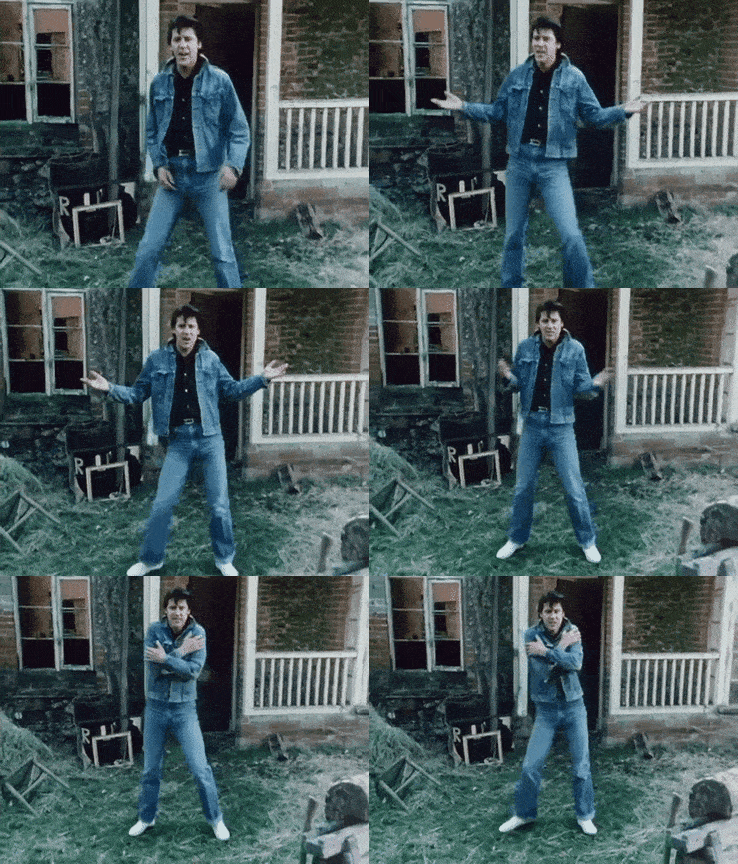
 Good Old shakin’, although we have a black door!