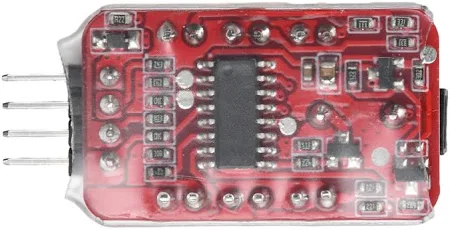
Is there a small, lightweight plug-in in-flight battery management system, with a JST-XH 3S male balance connector, utilizing the lithium-polymer's 3S JST-XH 3S female balance connector?

The reason I ask is that my OEM 11.1v 1.2Ah Parrot Bebop 1 Drone lithium-polymer battery, with its own internal battery management system, enjoys a 10-minute flight time, if held in a stationary hover, while each of my generic 11.1v 1.5Ah lithium-polymer batteries (no in-flight battery management system) last only 5 minutes of flight time, if held in a stationary hover.

I am aware that passive balancing is slow and generally not effective for the rapid discharge cycles experienced during flight. And the thin wires of the JST-XH balance plug (typically 22 AWG) are designed for low-current balancing and monitoring, not for high-current discharge or active, high-speed in-flight balancing.

But I’ve examined the thin wires used in the OEM Parrot Bebop 1 Drone lithium-polymer battery’s internal battery management system, and now understand why the OEM battery was only rated at 10C.
I’m tempted to cannibalize the battery management system out of one of my dead OEM Parrot Bebop 1 Drone batteries for this… and wired up to a JST-XH 3S male balance connector.

Any suggestions?

My 2 cents - I do not believe adding a battery management board will have any impact on flight time - they do not regulate ‘normal use’ discharge and as you mention passive balancing is so slow it will not have any impact during flights.

The batteries (OEM <> generic) are likely just very different (battery cells are optimized for specific discharge rates - different chemistry, different anode/cathode surface area, thickness, quality,…) which can give huge performance variation between brand/models - with some brands claiming crazy unrealistic ratings

Looks like you could mod the drone to use standards FPV batteries - you would then be able to use modern packs that should outdo even your OEM ones (look into Li-Ion cells if you want maximum flight time)

3 Likes

Reading further about this on the internet, the OEM 11.1v 1.2Ah Parrot Bebop 1 Drone lithium-polymer battery does have a built-in but rudimentary battery management system, but only for temperature monitoring with auto-cutoff… not enough to be a true “smart battery” as it still doesn’t provide real-time cell balancing while in flight… which, unfortunately, is what I am looking for.

The image of an unrelated electronic device I uploaded is simply to illustrate what such a device might look like, if in fact it even exists in the universe. To be sure, such a circuit appears too light and skimpy, but there again, the OEM 11.1v 1.2Ah Parrot Bebop 1 Drone lithium-polymer battery only has a 10C discharge rating.

When in flight, the OEM 11.1v 1.2Ah Parrot Bebop 1 Drone lithium-polymer battery is only utilizes its standard two-wire +/- 11.1VDC connection with the Parrot Bebop 1 Drone when flying. So, for convenience and economy, I’ve already swapped out the OEM Parrot Bebop 1 battery onboard proprietary connector with a standard XT30 male FPV battery connector, so as to accept slightly higher capacity 1.5 Ah FPV batteries.

And I suspect the information I’ve found on the internet may be inaccurate, as I initially expected the OEM 1.2Ah 10C battery to field test at a performance level slightly less than a generic 1.5Ah 30C battery, as I tested both with my Parrot Bebop 1 Drone at a level, stationary hover… just to keep things constant and accurately judge the difference between the two.
But I was quite surprised that the lower capacity Parrot Bebop 1 Drone OEM battery hovered for 10 minutes, versus 5 minutes for each of the higher capacity generic batteries.
Sure, different batteries may have different results. But lithium-polymer batteries, quite unlike cylindrical lithium-ion batteries of the same size, have very little difference in mAh performance of two different 3.7V cells of similar weight and similar volume. In fact, I’ve put unlabeled single 3.7V lithium-polymer cells on a gram scale, and also measured their 3 dimensions to accurately determine the mAh capacity.

So, to make a long story short, if I don’t hear anything from the online drone forums, I will take out and wire the internal battery management system circuit board from a dead OEM Parrot Bebop 1 Drone lithium-polymer battery, soldering in the four wires to a male JST-XH 3S balance connector… and then connect my BMS rig to the battery right after it has been fully charged, when all 3 cells are at the same voltage.
Really.
I have a sneaking suspicion the internal battery management circuit board of the OEM Parrot Bebop 1 Drone lithium-polymer battery just might in fact be a true “smart battery” and may very well provide real-time cell balancing while in flight.
But we shall see.
And if in fact it works, and successfully tests out over a number of flights, I’ll upload a detailed description as well as an image of my makeshift but lean-and-mean rig.

Stay posted.
This is incorrect - you will have massive difference between lipo batteries energy density

I can only repeat that a ‘smart battery’ does not offer longer flight time - with or without cell balancing. It is a system to protect the battery against specific scenarios and has no impact on ‘normal discharge’.

Okay guys,

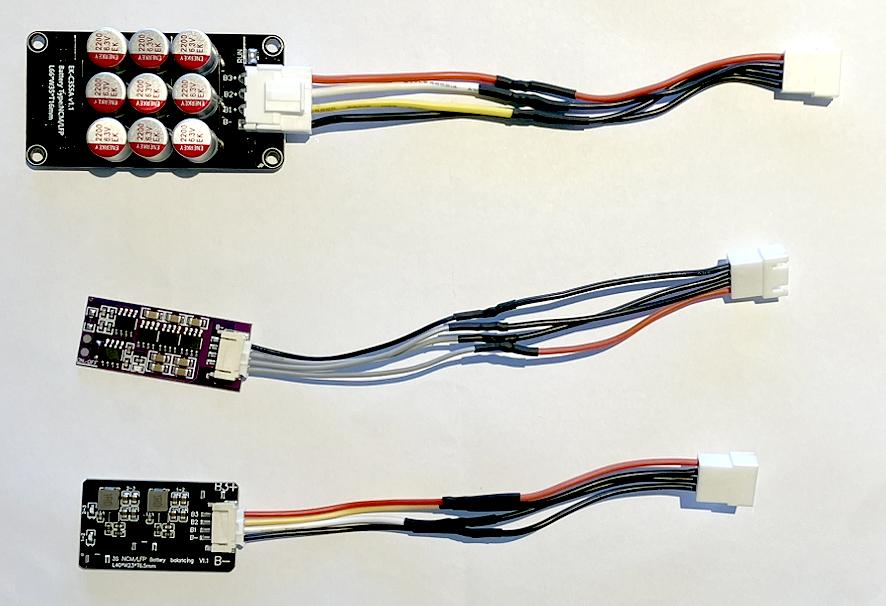
I purchased and test ran four of these small, cheap 3S Active Balancer Boards to, hopefully, keep all 3 cells of my 11.1V 1500mAh LiPo battery balanced while in-flight. These are marketed as miniature 1.5A BMS circuits, but none were marketed as possible in-flight discharge BMS for radio control toys.
I balance-charge my 11.1V 1500mAh LiPo batteries with my Tenergy TB6B charger, and also store-charge my batteries after using them, so the 3S Active Balancer Boards I tested out were only needed as an in-flight BMS.

But, to make a long story short, they don’t work for my RC purposes.

Instead of a 5-minute flight at a stationary hover, I was getting only 4-minute flights.
But more importantly, all of the circuit boards produced RF interference, either over the airwaves, or directly into the wiring, or both, that made control of my usually stable Parrot Bebop 1 quadcopter testing extremely difficult. This is not uncommon with internal battery power electronics, as I’ve experienced the same RF interference when trying to power a 2-way radio with a 9V LiPo transistor radio size battery.

I’m also providing a photo of the three different types of Active Balancer Boards I tested, with the pigtails I added to directly connect to 4-pin balance connector of my 11.1V 1500mAh LiPo battery.

Any suggestions are appreciated.