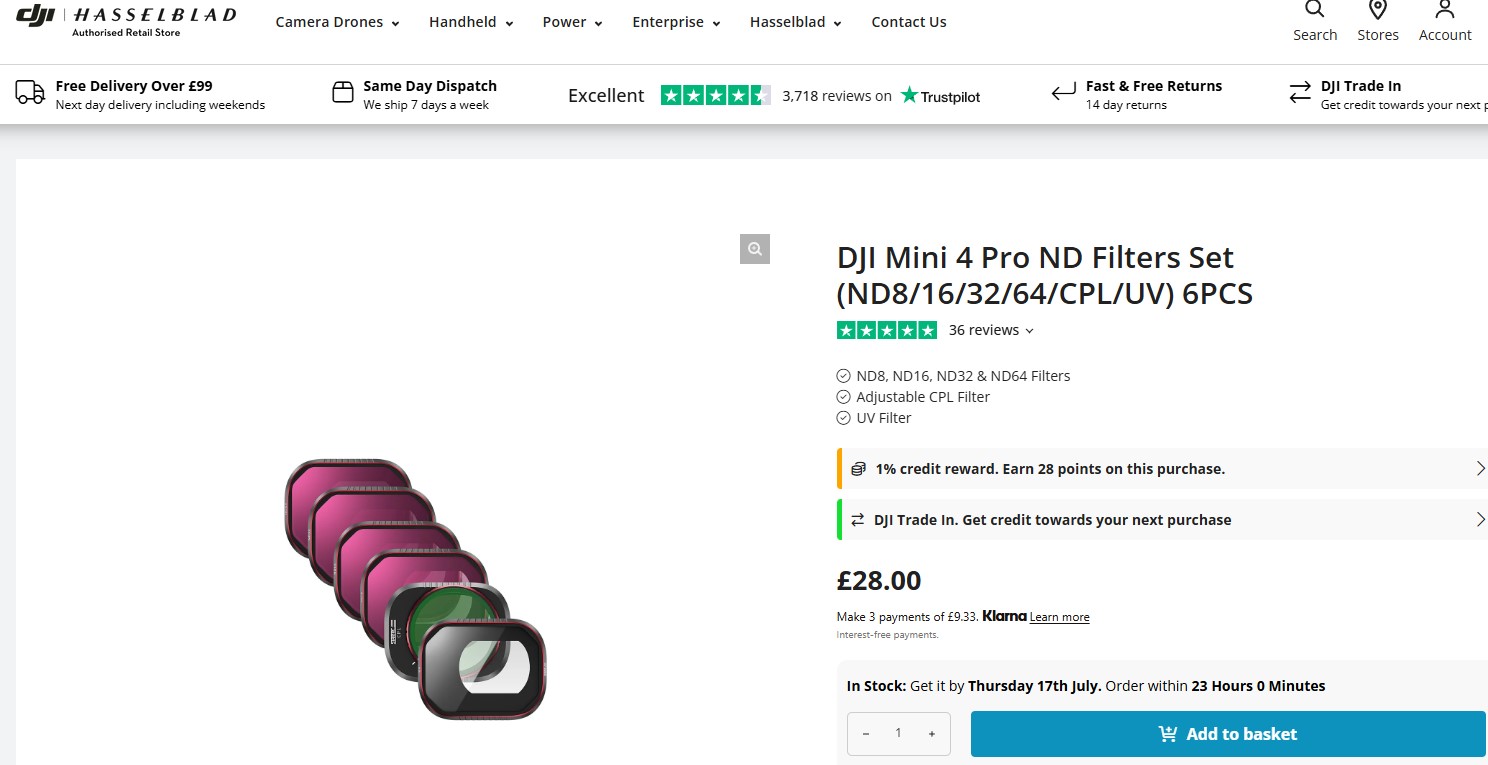
Hi fellow members. I am looking the buy my first set of filters for my Mini 4 pro. Could anyone advise if these would be suitable as a starter kit? Thanks in advance guys..

I’m probably a bit of a Luddite but I got these for my Mini 4 Pro 12 months ago and have still not used them. Maybe the brilliant sunshine we’re having in some parts of the country may force me to do so in the next few weeks or maybe someone here will explain how they can improve things……
@DISC ND filters reduce the amount of light going into your camera.
If there is less light in any situation you either have to use a slower shutter speed or increase the sensitivity (ISO). If the camera has a variable apperture you can also use that to compensate.
Use your camera in manual, if you leave the exposure set to auto the drone will bump up the ISO to compensate for the lessened light coming to the sensor, increasing the noise and degrading the image.
Normally they are used in drone photography to use a slower shutter speed typically either for long exposure times to get motion blur or light trails in still photography or to get the shutter speed down to a “cinematic” level in video photography
In bright light you will get a typical shutter speed of !/1000 second. A video is normally composed of 24 or 25 individual pictures (frames) per second (fps) 25 perfectly sharp ictures per second give an unmatural feel to your video.
By exposing eacgframe for a speed of 1/50 second (for 25fps) there is a certain amount of blur due tothe subject and/or the camera moving. Seeing those pictures in sequence allows them to blend more successfullly into the illusion of flowing (“cinematic”) movement.
Projecting perfectly sharp images captured at a high shutter speed produces a minutely jerky feel to the video that some people notice and dislike.
So a neutral density filter is purely to give you more control over your shutter speed.
In the set Glenn - @Silverback - has highlighted abovethere are five ND filters ND8 - reduces the amount by 8 times, would drop the shutter speed from 1/1000 to 1/125 for example. ND 16 - 1/1000 to 1/60 and so on.
An ND filter can also be described in terms of the number of iris stops a lens would have to open to compensate for its shade - ND8 is 3 stops, ND 16 4 stops and so on.
A neutral density filter does nothing to change the colour balance or contrast it is, as the name suggests, neutral.
The final filter in the set Glenn is thinking about is a CPL. A circular polariser. It reduces reflections from surfaces like water or glass. It can enhance pictures, mainly by darkening the sky. For the best effect it needs to rotated into the best position according to the angle between the cameras and the surface, not easy when your camara is 200 metres distant and 50 metres above you!
I’m quite prepared to believe that I am in a minority of one but having spent 60 years taking the sharpest, most contrasty pictures I can, I really don’t want to blur my movies. Most of the examples of ND filter use that I see just look incompetent to me.
Using an ND filter does not relsult in a blurry picture as such. It is a piece of (hopefully) optically flat glass that has no more distortion than a UV filter which most photographers I know use as much to protect their front lens element as to reduce the effect of UV in their pictures.
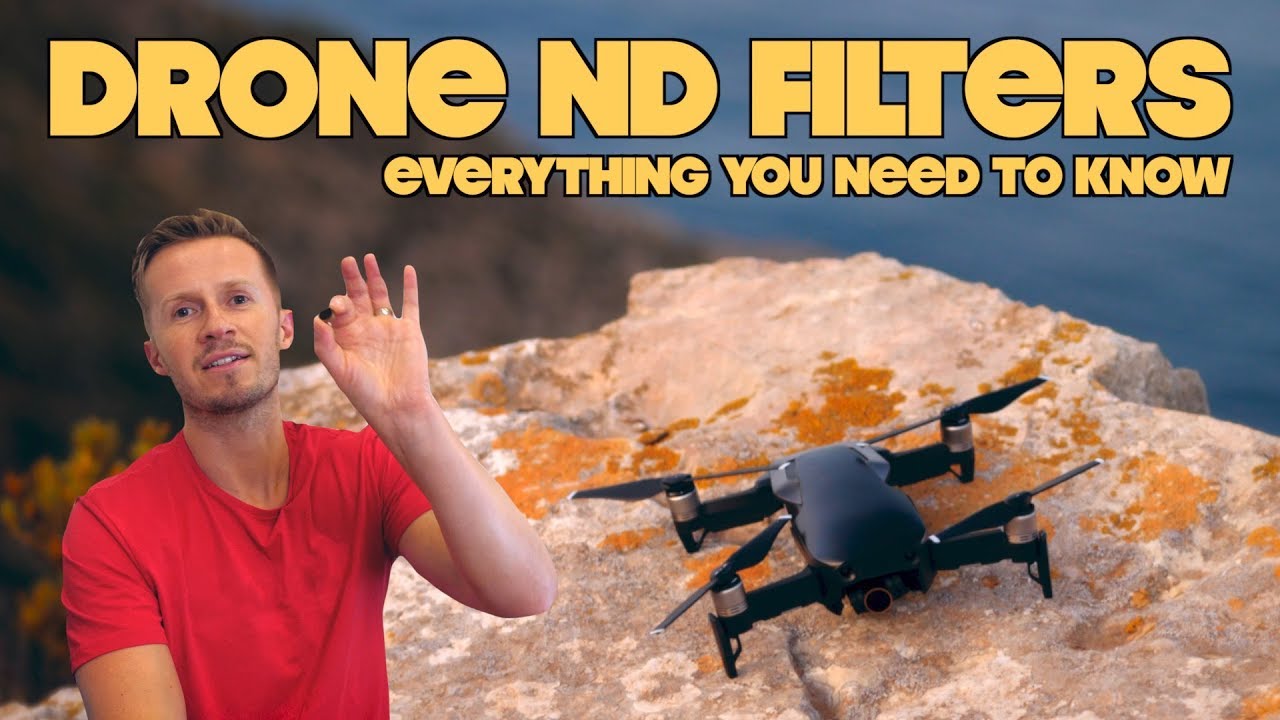
As shown in the video above at 13:42 a series of pictures without any motion blur look unnatural with one element moving, in this case the birds moving across the frame seem jerky or staccato, using a slower shutter speed as an ND filter would allow would smooth out the motion of the birds, looking far more realistic.
ND filters are a means of reducing the light coming through the lens iris and hitting the film or sensor. No more, no less. They will have no influence on contrast or colour if they are, indeed, neutral.
You can use them to allow slow shutter speeds or wide apertures rather than alter the ISO settings.
In still photography you can have an insanely sharp picture of a waterfall with your camera on a tripod, a slow shutter speed achieved by the use of an ND filter will allow the rocks to be razor sharp while the water blurs to show motion.
Most classic films were shot at 1/50 second. Pictures like Citizen Kane or Stagecoach. Angels with Dirty Faces or Gone with the Wind. The cinematographers and directors certainly didn’t want to create blurry pictures but the motion in the otherwise sharp pictures looks fluid and natural.
Following a childhood interest I did a four year degree level photography course at Manchester in the early seventies. In my sixty years of photography and videography I have used blur when appropriate to create a feeling, a mood or an interpretation of a situation.
tl;dr I too like sharp, contrasty moving pictures, I also prefer the motion to be fluid, not jerky. ND filters allow that.
Firstly, many thanks for all that responded to my enquiry. The video (Captain Cornelius) macspite@DISC provided was extremely informative. On conclusion, regarding the purchase of ND & CPL Filters, I feel that it would be wise for me to have them in my drone bag and not need them, rather than need them and not have them. I have now purchased a starter set from Hasselblad as they are an authorised DJI accessory dealer. Although those I originally saw on amazon, such as ‘Neewer’ and ‘Freewell’ appear quite adequate, many buyers were disappointed in them in their reviews with the len’s not fitting properly or the wrong model sent to them.
I agree with your points about blur, and I especially hate those awful long exposures of waterfalls that people who think they are being clever do; my aim in taking such images is to be able to see each individual droplet.
I do use ND filters on very bright days, though, and a CPL to control reflections. The point being made by Macspite was, I think, that ND filters can be used to induce blur in brighter conditions; whether or not they should be used in this way is another matter, and I think I could predict what our response would be, but it’s a matter of taste!
Horses for courses. My PhD research was into image texture, and for that you need sharp and clear images. If you are more interested in the effect produced by your movie than in its content, induce some blur. I use drone movies to generate 3D stills, so for me crispness rules.
Another use case is to get motion blur into a timelapse/hyperlapse. This is the main reason I bought a set. The goal in my case to record the motion of the drone camera smoothly, so that the passing of individual frames can’t be easily discerned but have any motion within the frame to be nicely blurred.
I guess it is just a case of getting everything right on the day, lighting, exposure using ND filters to get the shutter speed long enough to get blur of objects moving within the frame but not so long as to introduce blur across the whole frame, also frame-rate/drone-speed to smooth the passing of one frame to the next.
All very subjective of course, which is why I say “the goal in my case”.
I still haven’t got it completely right yet! As I usually say: “Oh, well keep trying”. 
None of this of course can’t be acheived by speeding up normal footage.
Before I got into drones I used to capture a lot of long exposure images in both day and night conditions. Why on earth would you presume photographers think they are ’ being clever ’ in capturing such images. 
It’s called taking your camera off the automatic settings and discovering what you can do in manual mode. I found the hobby very rewarding.
Oops, didn’t mean to ruffle feathers, just put my pov over. I also take images with manual override, on my DSLR, iPhone, & Drone, for similar reasons to yours; to get the specific type of image I want. ‘Auto’ is great for snapshots; I take snapshots but my proper photography involves pre-thinking and planning the exposure (i’d be a crap press photographer), and this happens ‘off auto’. As applied to Drones, and moving images, I’m still not very far up a steep and large learning curve, but quite a bit of my previous technique applies!
There are other opinions and approaches besides mine, and no law to say that anyone has to agree with me or do what I do, and you are more than welcome to disagree with me, but I have a particular dislike for blurred waterfall images. I don’t see the point, and as a photograph, that is, a record of the waterfall at the time that the shutter was pressed, it is false, a lie, dishonest, mendacious, and, in my view, a cheap trick. A photograph should (again, in my view, and there are others) record reality as best it can, and although the photographer can tweak settings and, in the digital age, post-edit the image to artistically create a specific effect, atmosphere, or mood, I believe that the truth should not be compromised; and blurry water is not reality. Real water is never blurry unless you’re short sighted!
Oh, I’ve done the blurry water thing, to see if I could, and have some shots I took at Southendown in twilight some years back which have the resultant milkymisty effect around the rocks as the tide came in; I rather like these, very moody and surreal. But the approach is hackneyed to death with waterfalls! Waterfalls are wild and violent, and this techique sort of tames them and makes them presentable for genteel society, and I’m anathema to genteel society, and the concept of such abonination!
I also find the hobby very rewarding, largely as a result of exploring the world beyond ‘auto’.
“I don’t see the point, and as a photograph, that is, a record of the waterfall at the time that the shutter was pressed, it is false, a lie, dishonest, mendacious, and, in my view, a cheap trick. A photograph should (again, in my view, and there are others) record reality as best it can”
Sorry Johnster, but what absolute pish. You’ve not really ever studied photograpgjy or its art, have you? Fair enough if all you want to do is record a scene, but 99% of the photographers i have evet met are the exact opposite
FFS guys chill, photography and videos should mainly be an art and the technique depends as much on taste/preference as much as purpose. For waterfalls/streams I tend to bracket my shots at different shutter speeds to get the effect I want, I haven’t tried with the drone yet but I expect using different ND filters will do the job. For now I use a UV on one drone and a CPL on the other so I can see through to the beds of rivers and lakes to record things. CPLs are a bit of a faff but I try to set it up before I release the drone into the wild.
That is me chilled out @WhiteIsle , you should read the other stuff I post to @TheJohnster 
Yep he posts a load of bollox IMHO.
Maybe he should get out there and start posting up images in the daily photo threads instead of pontificating with pages of drivel.
Reminds me of the conversation overheard of two visitors admiring Van Gogh’s The Starry Night. One expressed how the painting spoke to them and moved them, the other said, “Yeah, it’s good. Shame he didn’t make it more realistic though”. 

F*** I bandy!
A name change and a headectomy and you’ve become mild-mannered Clark Kent
Where’s the old firebrand Scottish Superman whose name was Joe?
Late to the party but my 2 pence worth…
I come from a photography background and do both art (photo manipulation) and record (straight out of camera) photography. Both have a place and i do appreciate, straight out of camera doors have the camera own processing so no picture is ever “not processed”.
In art, I sometimes want to slow motion down so, for example I want to see the water droplets in a water spout or waterfall and sometimes I want to speed other things up, like a car moving (a car can look very flat and boring if it looks static but if you can get some background and wheel motion blur the image comes to life). In landscape photography, slowing the shutter speed also allows manipulation of depth of focus workout or with very little, degrease of photo quality/noise introduction.
But in drone photography, I do much less. I want to reproduce colours correctly, keep the noise down, occasionally get background blur but find I don’t need to worry so much. I know in manual you can change the photographic settings etc but as i move my drone around so much and done film cine stuff all that much I rarely play much with these once I’ve taken off. Maybe I might do if i want to produce a film or something… yeah right!
So, I bought StartRC filters, the 6 pack including CPL (that i will probably never use and can’t see the point as unless I can adjust it mid-flight, it doesn’t do much for me), UV filter, that life my cameras, is always installed on the drone unless using another filter and several ND filters. With the ND filters, I have used 8 and 16 extensively as they really help the videos stand out and once I used the 64 in extreme sunlight on a beach. The only other thing I bought was a DJI wide angle strictly for Photogrammetry as it allows 3D modelling to have better texture panels. The StartRC version isn’t quite a pure curve so some added distortions are present around the edges and less of each photo is available for reconstruction.
Each to their own though, purists and artists but most importantly, it depends on what you are imaging/filming and what you are looking to get out of the camera.
You will always find opposing opinions on this and heated debate but it is always down to the person being the camera to choose their style. I didn’t buy expensive as the drone was comparatively cheap compared to my DSLR or even my cheapest lens which is more than the price of the whole drone package! Still, the drone take spectacular pictures and video, and for my use, filters boost my recordings so I use them as I think i need them based on what I’m doing and what I’m after.
Above all enjoy and there is no harm in trying a few different things. You can always sell them on if you don’t use them or trade them in for more expensive ones if you want more it of them. I went cheap and reasonable and I haven’t looked back and wished I hadn’t spent the money although i would probably have bought the smaller set if they did them in the ones I use (which they don’t)
I have a set of ND filters but UV is a must in my humble opinion, helps reduce haze in landscapes and gives a slightly warmer feel to the image . A polariser is useful for a lot of what I shoot, yes it is a faff and I can understand it won’t be much advantage to many but I try to set it up before take off.