UK Class Marks, Remote ID and drone regulation changes: What you need to know for 1st January 2026

You are correct on the basic principle. Aviation authorities have never expected pilots to stare only at the drone and ignore telemetry. If that were the case, every flight would need a spotter. The accepted reality is that you switch attention between the aircraft and the screen. What’s tightening now is the expectation that the drone remains continuously visible and clearly identifiable to you, not that your eyes never move.

This is where AR glasses can make sense.

If the AR glasses are acting like a heads-up display, with telemetry, map, or camera feed floating in your field of view while you are still directly looking at the drone with your own eyes, that actually strengthens the VLOS argument rather than weakening it. You are not burying your head in a controller screen. You are keeping your gaze up, maintaining spatial awareness, and only glancing at overlays.

The key line regulators care about is unaided visual contact with the aircraft. AR glasses do not automatically violate that, as long as:

You can clearly see the drone with your naked eyes
The glasses are transparent, not immersive
The drone is not being flown solely by reference to the camera feed

What would be a problem is using AR glasses like FPV goggles, where the outside world disappears and the drone is only seen through the camera. That is no different from traditional FPV and would still require a spotter unless you’re flying under the appropriate permissions.

So practically speaking:

Looking at the drone while flight data floats in AR: reasonable and defensible
Flying mainly by the camera feed, even in AR: still not VLOS
Using AR to reduce head-down time and improve awareness: actually aligns with the intent of the rules.:smiling_face:

I wonder why they don’t state that then?

2 Likes

Aviation regulators move slowly and deliberately. When they write rules, they try to describe what must be true rather than how you achieve it. If they started listing specific technologies, the rules would be outdated almost immediately. Ten years ago AR glasses weren’t a realistic consumer tool. Five years from now, something else will replace them.

So instead of saying “you may use AR glasses” or “you may glance at a screen,” they anchor everything to principles like:

unaided visual contact

ability to determine position, attitude, and direction

effective collision avoidance

That gives them flexibility, but it also creates grey areas for pilots who think in practical terms.

There’s another layer too, and this is the part people don’t always like. Ambiguity gives regulators room to judge behaviour, not just equipment. If the rule said “AR glasses are allowed,” someone would inevitably push it too far, fly beyond realistic visibility, or effectively fly FPV and argue they’re compliant. By keeping it principle-based, enforcement can look at what you were actually doing, not what you were wearing.

And finally, a lot of this comes down to legal defensibility. Clear, simple wording like “maintain VLOS at all times” is much easier to defend in court than a long list of exceptions and technologies. Case law and guidance videos, like the ones Ian puts out, are where the practical interpretation shows up, even if the regulation itself stays high level.

In short, they don’t spell it out because:

technology changes faster than regulations

they regulate safety outcomes, not gadgets

grey areas give enforcement discretion

simpler rules are easier to uphold legally😉

Seems to me that virtually no off-the-shelf drones have controllers with a dedicated feed specifically for AR / MR glasses which only show the telemetry data. So we’re pretty much talking, for most folk, about wearing a pair of glasses that overlays the full screen from your controller right in the middle of your sight-line.

One of the big problems with reacquiring sight of your drone after you’ve glanced at the controller is background masking, where it blends in with whatever is behind it and is difficult to see.

I’m not sure trying to also keep sight of the drone after you’ve essentially introduced ‘foreground masking’ as well is an improvement.

At the end of the day, you should be regularly scanning your surroundings for potential hazards - uninvolved people/animals coming in to your flight area, approaching aircraft, etc - including behind you. If you’ve got your eyes locked on your drone, even if you can still see your telemetry data, then you aren’t following the spirit or intent of the rules.

I think you’re basically right, and you’re touching the bit people often skip when they get excited about the tech.

In the real world, most consumer drones were never designed with AR as a first-class feature. There isn’t a clean, secondary telemetry-only output. What people are actually doing is mirroring the full controller screen into glasses, and that changes the equation a lot. Once you put a live video feed right in the middle of your vision, it’s no longer just a heads-up display. It competes for attention whether you want it to or not.

Your point about masking is a good one. Background masking is already a known problem when reacquiring a small aircraft against trees, buildings, or cloud. Adding a bright, moving foreground element increases the cognitive load, not reduces it. Even if the drone is technically still visible through transparent lenses, your brain is now doing more work to separate layers. That’s not free, and it’s not obviously safer.

The scanning point is the big one for me. VLOS has always been shorthand for something broader: maintaining overall situational awareness. That includes people wandering into your area, dogs, cyclists, and aircraft you’re not expecting. It also includes checking behind you and around you. If AR use pulls you into a fixed forward stare, even with good intentions, you’re arguably drifting away from the spirit of the rule, not closer to it.

So I’d frame it like this:

AR can support VLOS in theory, but most off-the-shelf implementations today don’t. Without a true telemetry-only overlay, you’re effectively putting an FPV-style stimulus into your primary field of view. For some pilots, that may reduce head-down time. For others, it may increase fixation and reduce environmental scanning. Regulators can’t assume competence, so they default to conservative language.

That’s probably why the rules stay vague and why you won’t see AR explicitly endorsed anytime soon. The moment it becomes common, the safety conversation won’t be about whether the drone was visible, it’ll be about whether the pilot was actually aware of what was happening around them.

In other words, your instinct is solid. The tech isn’t the problem, the way it’s currently implemented is. Until controllers are designed with proper, minimal AR outputs and pilots are trained to use them as a glance tool rather than a focal point, AR is at best neutral and at worst a distraction dressed up as progress.:collision:

1 Like

I’ve been reading about all these changes and still very confused by it all.

I just want to know what I need to do for my Mini 4K and Neo :joy::joy:

I don’t think the requirements of VLOS are tightening. I think they are just making the requirements more explicit. The rules are the same as they ever were. You don’t have to stare at your drone the whole time. You don’t need a spotter unless you’re flying in FPV. You can look at your controller whilst flying. You must be able to re-acquire your drone immediately, if you were looking at the controller. There’s nothing new in terms of what is required.

3 Likes

You’ll find your answers here @sim667 :smiley:

2 Likes

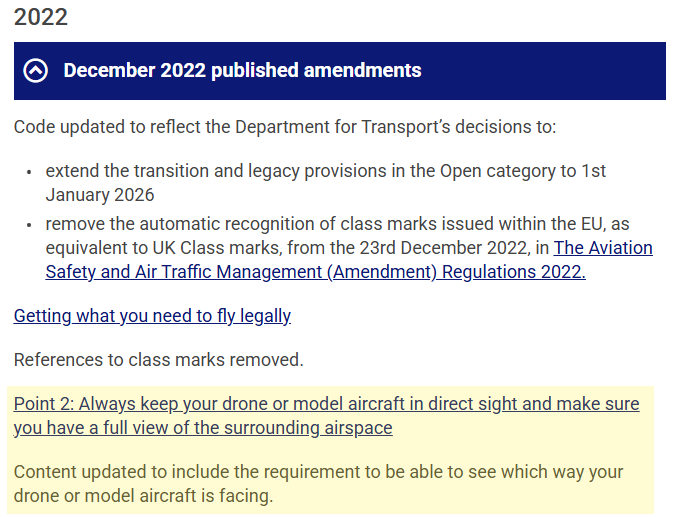
Apologies if I have missed something but I don’t think VLOS rules have changed or even been further clarified since about three years ago when the CAA updated their guidance on VLOS to say that you needed to be able to see which way your drone was facing. This is an extract from the CAA website showing the amendment:

I think the specific wording around FPV flying on the CAA website has been updated in the past year but it looks like it has just been brought into alignment with the wording in the Drone Code about keeping your drone in “direct sight”. I can’t see how it materially changes anything.

I would absolutely agree with this and will be continuing to follow the guidance given in my A2 CofC training which said that I needed to find a way to divide my attention between the controller screen and the aircraft to avoid colliding with anything.

2 Likes

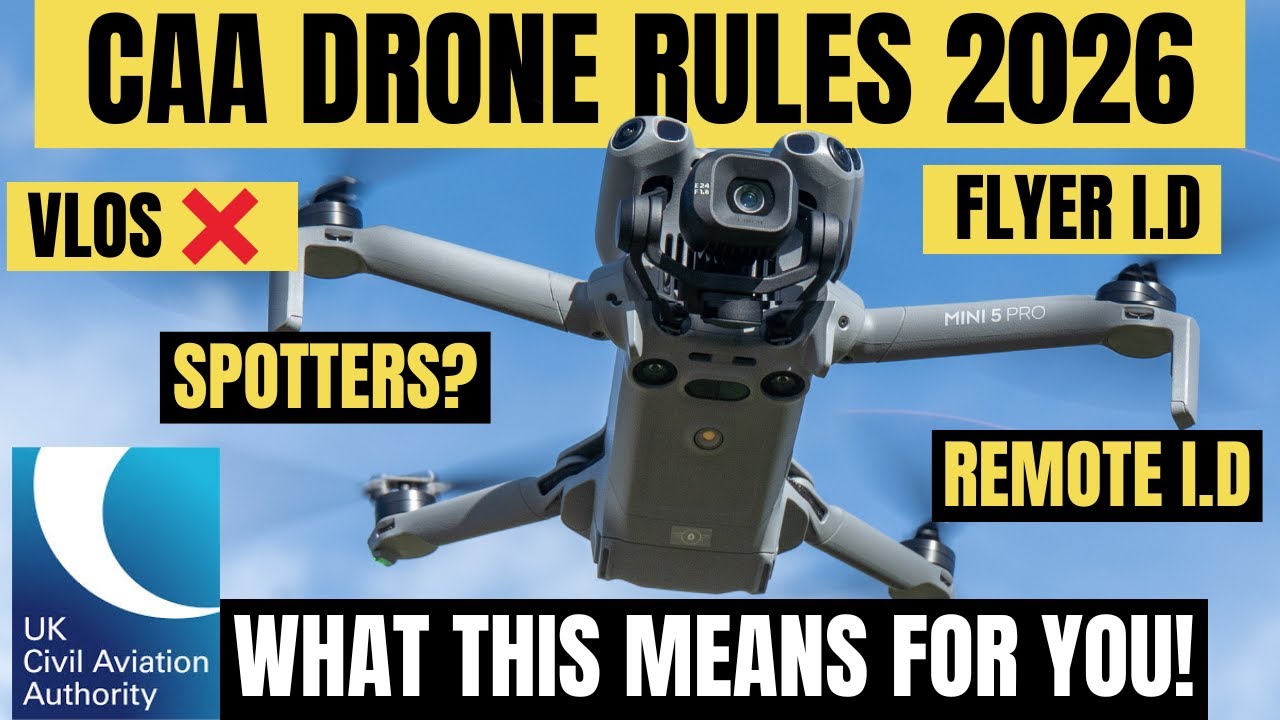
go to about 6.30 mins in and the new rules on VLOS. Is this really happening?

Robin @Djiman61 jump to post #390 in this thread - VLOS was discussed back in September :smiley:

it may of been discussed but in the video I posted it now states that you must always look at your drone and not your screen unless you have a spotter with you

As I mentioned, that video was posted in this thread back in September, scroll up to see the discussion and responses from other members that followed the video at the time.

Would be interested to hear your thoughts on it @Djiman61 ? :thinking:

to me it still looks like they are changing the ruling that you can only look at your drone while flying and NOT the controller unless you take a spotter with you or am I completely missing the point raised in the video

No, you’ve entirely understood the point raised in the video on VLOS … but he’s just plain wrong.

4 Likes

He did say that he’d been In touch with the CAA and they have confirmed that this is the case

No, he didn’t. He said in the video that he’d reached out to the CAA, he doesn’t say they’ve replied. And his pinned comment says the same:

I have emailed the CAA to clarify the spotter / observer requirement for flying ‘FPV’ as it is quite baffling to believe this is the case but that’s how the drone code shows - I will revert with any response I receive.

He hasn’t ‘reverted’ with anything, which I suggest means he either hasn’t received a reply in the last three months or the reply he did receive didn’t quite go along with his dramatic message.

I know the CAA can be slow to reply to emails, but I’ve never waited more than a couple of weeks and certainly never three months… so my money is on the latter.

Also in the comments he’s got numerous people (including me) telling him that the wording of the VLOS section he’s relying on for this “massive change” hasn’t changed at all with the update. It’s like talking to a brick wall - even when he’s shown the evidence that the wording is identical, he’s got to stick to his script because otherwise his click bait is showing.

2 Likes

Will have to wait and see then. I’m certainly not taking my wife (spotter) with me on every flight​:rofl::rofl:

1 Like

No! This guy is just plain wrong, but he’s generated a few more clicks on his video, so he’s probably quite happy.

Look, lots of people seem to be getting in a right tizz about the changes, but the CAA are not trying to ban you from flying. The rules don’t really seem that arcane to me (though admittedly things may be a bit different if you’re flying a home baked UAV). So:

  1. Stop worrying. Seriously!
  2. Carry on flying within the drone code, as you have been.
  3. Enjoy the extra freedoms you will get with a C1 drone.

Happy New Year and happy flying all :slightly_smiling_face:

PS - anyone else going to see the New Year in by flying their C1 where they could only previously fly a mini?

9 Likes

@GAVINHR can you share your response please